The fix is a single piece of hardware most people never notice until it fails: the door closer.
This article covers what a door closer is, how it works mechanically, why it matters across fire safety, security, energy efficiency, and hygiene, and which type fits which application.
Key Takeaways
- A door closer automatically returns a door to the closed position using a spring and hydraulic damping system, requiring no electrical connection
- Internal hydraulic valves independently control sweep speed, latch speed, and delayed action — preventing hard slams
- Serves five core functions: fire containment, building security, energy conservation, hygiene control, and privacy
- Main types: surface-mounted (three arm configurations), concealed, and floor spring
- Self-closing hardware is legally required on fire-rated doors, access-controlled doors, and qualifying walk-in refrigeration units
What Is a Door Closer?
A door closer is a mechanical device mounted on or near a door that automatically returns it to the closed position after each use. It stores the energy applied when opening the door, compressing or tensioning an internal spring, then releases that energy in a controlled way to bring the door back to the frame.
The formal definition comes from ANSI/BHMA A156.4, which describes the closer's function as pulling the door closed while providing checking control, two closing speeds, adjustable speed, and opening-angle control.
What It's Called
The industry uses several terms for this device:
- Door closer — the formal BHMA/A156.4 specification term
- Door check — older or informal usage, not a validated BHMA synonym
- Door controller — a broader industry category that includes closers, not an exact synonym
- Automatic door closer — potentially ambiguous; "mechanical door closer" is more precise when no powered opening occurs
When ordering replacement hardware or referencing compliance documents — for a walk-in cooler, freezer, or any commercial application — "door closer" is the correct term to use.
What It Looks Like
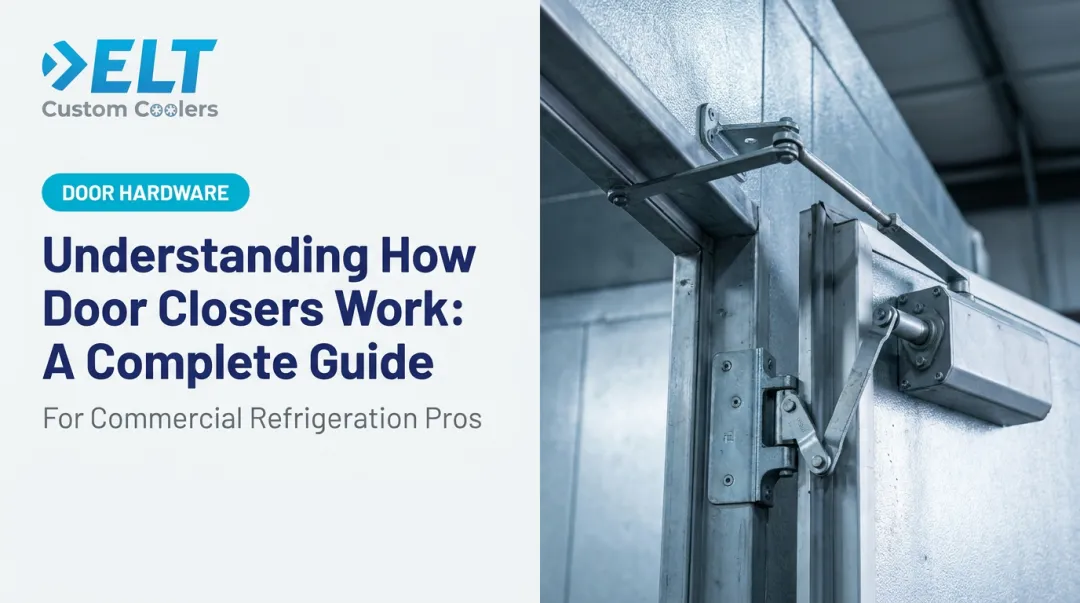
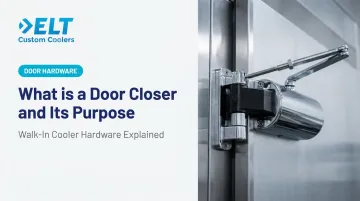
A surface-mounted door closer has a rectangular metal housing — the body containing the spring and hydraulic chamber — fixed to the top of the door or the door frame. A jointed metal arm connects the housing to the door, converting the door's rotational motion into compression and release of the internal mechanism.
Concealed versions are not visible when the door is closed. They are recessed into the door rail, the frame head, or the floor, with only a pivot point or a flush cap showing.
Door Closer vs. Automatic Door Opener
These two are frequently confused but serve completely different functions:
| Device | Power Source | Function |
|---|---|---|
| Mechanical door closer | Spring + hydraulic fluid | Controls closing after manual opening |
| Automatic door operator | Electric motor | Powers or assists the opening movement |
Automatic operators are governed by ANSI/BHMA A156.10 or A156.19 — entirely separate standards from A156.4, which covers mechanical closers.
How Does a Door Closer Work?
The Spring and Hydraulic System
When a door is pushed or pulled open, it rotates a spindle connected to the closer body. That rotation compresses or tensions the internal spring, storing mechanical energy. When the door is released, the spring pushes back, returning the door toward the frame. Without damping, that return would slam the door. Oil inside the closer body is forced through adjustable valve passages as the spring releases, slowing the return to a controlled, predictable close.
Most commercial closers include three adjustable valves:
- Sweep speed — governs the majority of the closing arc
- Latch speed — separately controls the final few degrees so the latch engages cleanly
- Delayed action — slows the early closing phase to provide more passage time, useful in high-foot-traffic corridors and accessibility applications
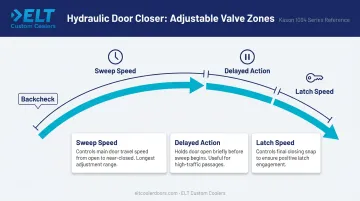
A backcheck function hydraulically resists rapid opening near the end of travel, protecting the door and wall from impact. It is not a door stop.
Those valve adjustments work within the context of the closer's underlying drive mechanism — and the two dominant types handle that translation differently.
Rack-and-Pinion vs. Cam Action
The two dominant internal mechanisms differ in how they translate door movement into spring compression:
Rack-and-pinion closers use a gear-driven system: the door spindle turns a pinion gear, which moves a rack connected to a hydraulic piston. The result is consistent, adjustable closing force across the full arc. Allegion's LCN catalog describes this as full rack-and-pinion hydraulic action, and it's the most common configuration in commercial buildings.
Cam-action closers substitute a shaped cam disc and roller wheel for the constant-leverage gear system. ASSA ABLOY describes the design as producing lower opening moment while maintaining closing force — useful where accessibility requirements and reliable latching need to coexist. These work well for doors that must meet ADA opening-force guidelines without sacrificing positive closure.
The Main Purpose of a Door Closer
Fire Safety
Fire-rated doors cannot do their job if they're open. IBC 2024 Section 716.2.6.1 requires covered fire door assemblies to be latching and self-closing or automatic-closing — and a mechanical door closer is the most straightforward way to meet that requirement.
FSRI's residential fire research found average temperatures below 100°F behind closed doors compared to over 1,000°F in open rooms during the same fire events. Commercial fire door assemblies operate on the same compartmentation principle: a closed, latched door slows the spread of fire and smoke between building sections, protecting occupants and limiting damage.
Section 716.2.6.5 of the IBC also permits delayed-action closers on doors that must be self-closing but not automatic-closing — useful in corridors where ADA passage time requirements apply.
Security
Access-controlled doors — those equipped with electric strikes, magnetic locks, or card readers — can only perform as designed if the door reliably returns to a closed and latched position. A closer removes the variable of human behavior from that equation.
Closers ensure a door shuts fully and latches completely, keeping every component of an access-control system functional. If the latch never reaches the strike, the lock never re-engages.
Temperature and Energy Control
For refrigerated environments, a failing door closer isn't just inconvenient — it's a compliance issue. 10 CFR 431.306, which has applied to qualifying walk-in doors manufactured since January 1, 2009, requires automatic door closers that firmly close doors brought within 1 inch of full closure. ANSI/ASHRAE/IES Standard 90.1-2022 Addendum r carries the same 1-inch requirement.
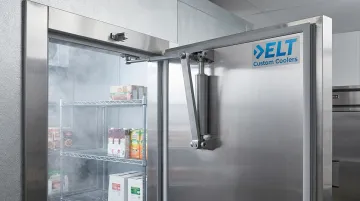
ELT Custom Coolers includes a door closer as standard hardware on their prehung walk-in cooler and freezer door assemblies — specifically to "assure door will be completely closed whenever it is left ajar."
Two closer models are available for this application:
- Kason 1094 SureClose™ — hydraulic closer for standard walk-in cooler and freezer doors
- Kason 1094S Dual-Speed Closer — adds a snubbing mechanism that provides an initial fast close to resist slamming force, then a slower secondary action to reduce final impact and protect the door seal
Hygiene and Pest Prevention
The 2022 FDA Food Code Section 6-202.15 requires food-establishment outer openings to use solid, self-closing, tight-fitting doors to exclude insects and rodents. Section 6-202.14 extends the same requirement to toilet room doors in food facilities.
In NSF-approved commercial environments, sanitation standards apply to the physical facility — not just the equipment inside it. A door closer that reliably returns a kitchen or food storage door to a fully closed, latched position is a direct compliance tool.
Privacy and Noise Control
Door closers on restroom doors, private offices, and soundproofed rooms serve a straightforward function: restoring privacy and reducing noise transmission automatically, without relying on users to pull the door shut. In high-traffic commercial buildings, that consistency matters — every door closes the same way, every time, regardless of who walked through last.
Types of Door Closers
Surface-Mounted Closers
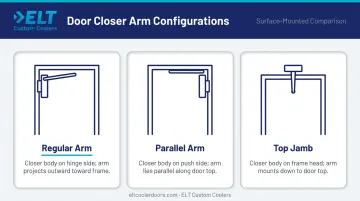
The most widely installed type in commercial buildings. Three main arm configurations cover nearly every mounting scenario:
- Regular arm — closer body on the pull/hinge side; arm projects from door to frame. Strong mechanical advantage, but the arm is visible and exposed
- Parallel arm — body on the push side; arm lies roughly parallel to the closed door. Less projection into the opening and better resistance to abuse in high-traffic settings
- Top jamb — body mounts on the frame head, arm attaches to the door. Used where door-rail space is limited, common on storefront and glass door applications
Concealed Closers
Hidden from view by being recessed into the door rail, the frame head, or the floor. Preferred when surface hardware would be visually intrusive, subject to vandalism, or at risk of damage from equipment traffic. Floor springs are a common variant in commercial entries where double-action or aesthetic requirements rule out surface hardware.
ANSI/BHMA A156.4-2024 covers surface-mounted, door-concealed, overhead-concealed, and floor-concealed closers — and requires Grade 1 closers to pass 2 million cycles.
Spring Hinges
Spring hinges combine the hinge and closing function into one component — no separate closer hardware required. They work on lightweight interior doors and are easier to install than overhead closers, but they lack hydraulic speed control. That means closing speed isn't adjustable, which matters when a door must meet ADA timing requirements or prevent slamming.
When Is a Door Closer Necessary?
Certain applications require a door closer by code — no discretion allowed:
- Fire-rated door assemblies under IBC 716.2.6.1
- Qualifying walk-in cooler and freezer doors under 10 CFR 431.306
- Food-establishment outer doors under adopted FDA Food Code provisions (Section 6-202.15)
- Toilet room doors in food facilities (FDA Food Code Section 6-202.14)
- Security access-controlled openings where the locking hardware depends on reliable re-latching
Even without a code mandate, a closer makes sense on doors with consistent foot traffic. Slamming risks injury and damage; an ajar door creates safety, hygiene, or energy loss issues that are straightforward to prevent.
Selecting the Right Closer
When a closer is needed, these factors determine which type and size to specify:
- Door width and weight — wider, heavier doors need higher power-rated closers
- Traffic frequency — high-cycle applications (grocery, restaurant, warehouse) demand Grade 1 durability
- Location — interior vs. exterior, exposure to weather or temperature extremes
- Fire rating — if the assembly is fire-rated, the closer must be compatible with the listed assembly
- Accessibility (ADA 404.2.8.1) — the door must take at least 5 seconds to travel from 90° open to 12° from the latch
- Opening force (ADA 404.2.9) — non-fire interior doors covered by ADA cannot exceed 5 lbf to open
Frequently Asked Questions
Is a door closer necessary?
Not every door legally requires one, but fire doors, security access-controlled doors, qualifying walk-in refrigeration doors, and food-facility exterior doors are all subject to code mandates. Even where not required, a closer is the practical choice on any door where slamming, uncontrolled access, or energy loss is a real operational concern.
What is the purpose of a door closer?
Door closers serve five core purposes — all dependent on the same mechanism: reliable, automatic return to a fully closed position:
- Fire safety — keeps rated assemblies closed and latched
- Security — allows access-control hardware to re-engage after entry
- Temperature control — limits cold-air infiltration in refrigerated spaces
- Hygiene — excludes pests from food-handling areas
- Privacy — ensures controlled, consistent closure in sensitive spaces
What does a door closer look like?
A surface-mounted closer is a rectangular metal housing fixed to the top of the door or frame, connected to the door by a jointed metal arm. Concealed versions are not visible when the door is closed — they are recessed into the door rail, the frame head, or the floor with only a pivot point showing.
What is another name for a door closer?
Common informal terms include "door check," "door controller," and "automatic door closer." In older usage, it may also appear as "door spring and check." Only "door closer" carries a formal definition under ANSI/BHMA A156.4.
What size door closer do I need?
Closer size, or power rating, is matched to door width. In the US, ANSI/BHMA grades sizes 1–6 based on door width and application — always verify against the manufacturer's tested fire assembly listing, since size-to-width mapping varies by series. For walk-in cooler and freezer doors, confirm the closer meets 10 CFR 431.306 closing-force requirements in addition to any fire-rating specs.
Can a walk-in cooler or freezer door use a door closer?
For most qualifying units, federal regulations require one. Under 10 CFR 431.306, walk-in doors must have an automatic closer that firmly closes the door from within 1 inch of full closure. ELT Custom Coolers includes a door closer as standard in their prehung walk-in door assemblies, with the Kason 1094 SureClose™ and 1094S Dual-Speed Closer available for applications needing two-stage closing action.