Introduction
For restaurants, grocery stores, and food distribution warehouses, cold refrigeration is a legal and operational requirement. A temperature failure means more than spoiled product — it can trigger a health code violation, a lost shipment, or a closed kitchen.
Still, most purchasing decisions focus on upfront cost while overlooking insulation R-values, or selecting a system without accounting for door-opening frequency — which research from the National Renewable Energy Laboratory shows accounts for over 50% of the cooling load in a typical walk-in cooler.
This guide covers the refrigeration cycle, the four main technology types, core system components, and what to look for when selecting or upgrading a commercial cold storage system.
Key Takeaways
- Cold refrigeration works by removing heat from a space, not by generating coldness
- Vapor-compression is the dominant technology for commercial cold rooms
- Air infiltration through doors accounts for over 50% of cooling load
- Federal standards require minimum R-25 (coolers) and R-32 (freezers) insulation
- DOE efficiency metrics — Annual Walk-in Efficiency Factor (AWEF) and Monthly Display Energy Consumption (MDEC) — are the standard benchmarks for comparing refrigeration equipment
What Is Cold Refrigeration and How Does It Work?
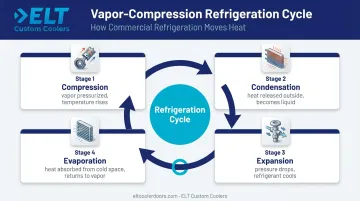
Cold refrigeration works by moving heat out of an enclosed space, not by generating cold. A refrigerant — a specially engineered fluid — absorbs heat inside the cold space and releases it outside, cycling continuously through four stages.
The four-stage vapor-compression cycle:
- Compression — The compressor pressurizes refrigerant vapor, raising its temperature
- Condensation — Hot refrigerant flows through the condenser coil, releasing heat to the outside air and becoming liquid
- Expansion — The expansion valve drops the pressure sharply, cooling the liquid refrigerant
- Evaporation — Cold refrigerant passes through the evaporator coil inside the space, absorbing heat from the air and returning to vapor — then the cycle repeats
The Role of the Refrigerant
Refrigerants are selected because they change phase (liquid to gas and back) at the low temperatures required for food storage. Early systems used ammonia and CFCs. Modern commercial systems have largely shifted to HFCs like R-404A, and increasingly to lower-GWP alternatives including R-448A and R-449A — driven by EPA AIM Act regulations that will reduce HFC production and consumption allowances to 15% of baseline by 2036.
The EPA's Technology Transitions requirements set cold-storage GWP limits of 700 beginning July 2027, dropping further in 2032 — making refrigerant selection a long-term compliance decision, with consequences extending well beyond the equipment room.
Why Insulation Is Just as Important as the Refrigeration Unit
The refrigeration system handles heat that enters the space. Insulation slows that heat entry, directly reducing the system's workload.
Federal minimums define the starting point for commercial installations:
- Cooler walls, ceilings, and doors: Minimum R-25
- Freezer walls, ceilings, and doors: Minimum R-32
Most quality commercial panels exceed these minimums. Four-inch foamed-in-place polyurethane panels commonly achieve R-28 to R-32 for coolers and R-32 for freezers. Poor insulation forces the compressor to run harder and longer, increasing energy costs and accelerating wear.
The Four Types of Refrigeration Technology
Commercial cold storage draws from four distinct refrigeration approaches, though one dominates by a wide margin.
Vapor-Compression Refrigeration
This is the standard for walk-in coolers, walk-in freezers, and large cold storage warehouses. A compressor pressurizes refrigerant vapor; the condenser rejects heat outside; the evaporator absorbs heat inside. The cycle is closed, continuous, and highly efficient at scale.
Vapor-compression systems are favored for commercial applications because they:
- Cover a wide temperature range (refrigeration down to deep freeze)
- Deliver COPs above 3.0 under typical operating conditions
- Support parallel rack configurations for large, multi-zone facilities
- Have a well-established service and parts ecosystem
Absorption Refrigeration
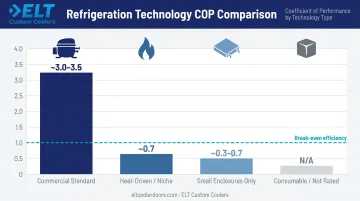
Absorption systems replace the mechanical compressor with a chemical absorber-generator process driven by heat — either a gas flame or waste heat from another process. They're quieter and can run without electricity, but CIBSE data puts their typical COP around 0.7, compared to approximately 3.5 for vapor-compression. That efficiency gap limits their use to specific scenarios: remote locations, facilities with abundant waste heat, or applications where electrical reliability is a concern.
Thermoelectric (Solid-State) Refrigeration
The Peltier effect passes DC current across semiconductor materials, creating a temperature differential where one side cools and the other dissipates heat. No moving parts, no refrigerant, and precise temperature control make this attractive for electronics cooling and specialty wine storage.
The limitation is efficiency. Research shows thermoelectric COP typically ranges from 0.3 to 0.7, well below commercial vapor-compression systems. At commercial scale, the energy cost becomes prohibitive. In practice, thermoelectric modules top out at small enclosures — wine cabinets, laboratory sample drawers, or point-of-use beverage coolers.
Non-Cyclic Refrigeration
Ice, dry ice, and liquid nitrogen cool by absorbing heat as they change state or sublimate. They're consumable, not mechanical — making them practical for transport, lab work, or short-term cooling, but not permanent storage.
Quick COP Comparison:
- Vapor-compression: ~3.0–3.5 (commercial standard)
- Absorption: ~0.7 (heat-driven, niche applications)
- Thermoelectric: ~0.3–0.7 (small enclosures only)
- Non-cyclic: N/A (consumable, not rated by COP)
Key Components of a Commercial Cold Refrigeration System
Every vapor-compression system depends on the same core hardware, regardless of whether it's a small restaurant walk-in or a large distribution center:
| Component | Function |
|---|---|
| Compressor | Pressurizes refrigerant vapor — the system's engine |
| Condenser unit | Rejects heat to the outside environment |
| Evaporator coil | Absorbs heat from inside the cold space |
| Expansion valve | Drops pressure to trigger phase change and cooling |
| Control panel | Monitors temperature, cycles equipment, triggers alerts |
Parallel Rack Systems for Larger Facilities
In supermarkets, food distribution centers, and large cold storage warehouses, parallel rack compressor systems network multiple compressors together. The advantages are practical:
- Load balancing: Compressors cycle on and off based on actual demand, avoiding the energy waste of continuous full-capacity operation
- Redundancy: A single compressor failure doesn't shut down the facility — remaining units hold temperature while repairs happen
- Multi-zone flexibility: One rack can serve produce, dairy, and freezer zones at different setpoints from a single system
Supporting Components That Complete the System
Refrigeration equipment keeps the space cold, but these supporting components determine whether that cold air stays where it belongs:
- Door seals, gaskets, and sweeps: Air infiltration is the single largest heat gain source in most walk-ins. A failed gasket forces compressors to work harder and can spike energy bills noticeably before anyone notices the seal is gone.
- Strip curtains: Secondary barriers installed at the doorway that cut infiltration during busy periods when doors open frequently
- Drainage systems: Manage condensate runoff to prevent standing water, mold growth, and slip hazards
- Shelving layout: Overpacked shelves block evaporator airflow and create warm pockets — spacing matters as much as setpoint
- Remote monitoring: Temperature and humidity sensors that send alerts when conditions drift, giving operators time to respond before product is at risk
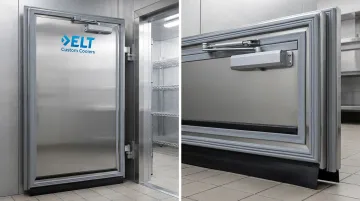
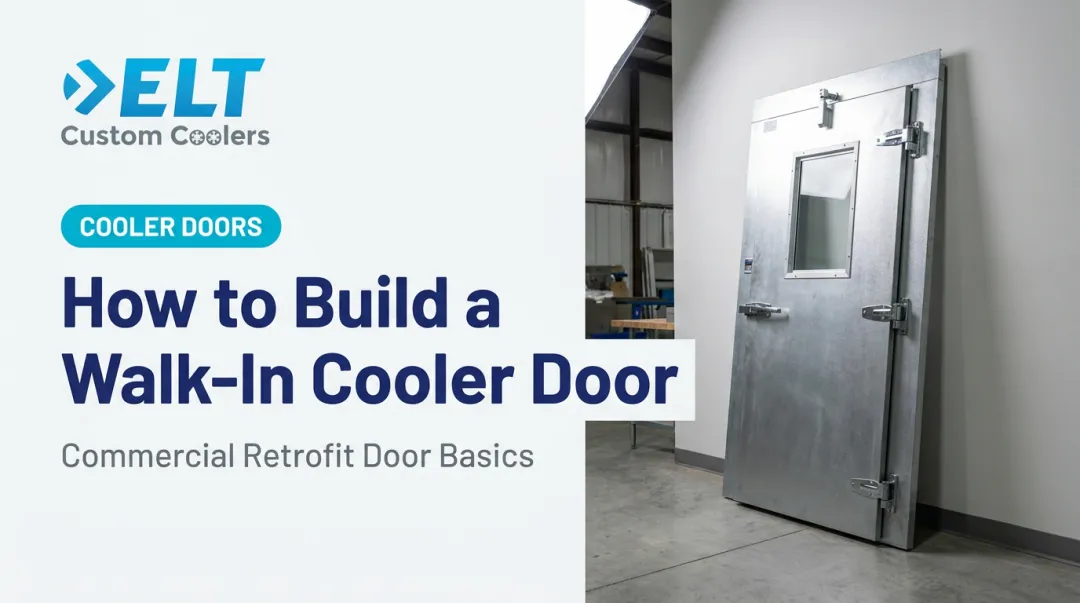
For operators focused on the door side of this equation, ELT Custom Coolers manufactures replacement walk-in cooler and freezer doors with magnetic door gaskets, double-sweep gaskets, automatic door closers, and anti-condensate heat wire on freezer models. All hardware is NSF-approved and addresses the components most directly responsible for air infiltration control.
Types of Commercial Cold Storage Solutions
Walk-In Coolers
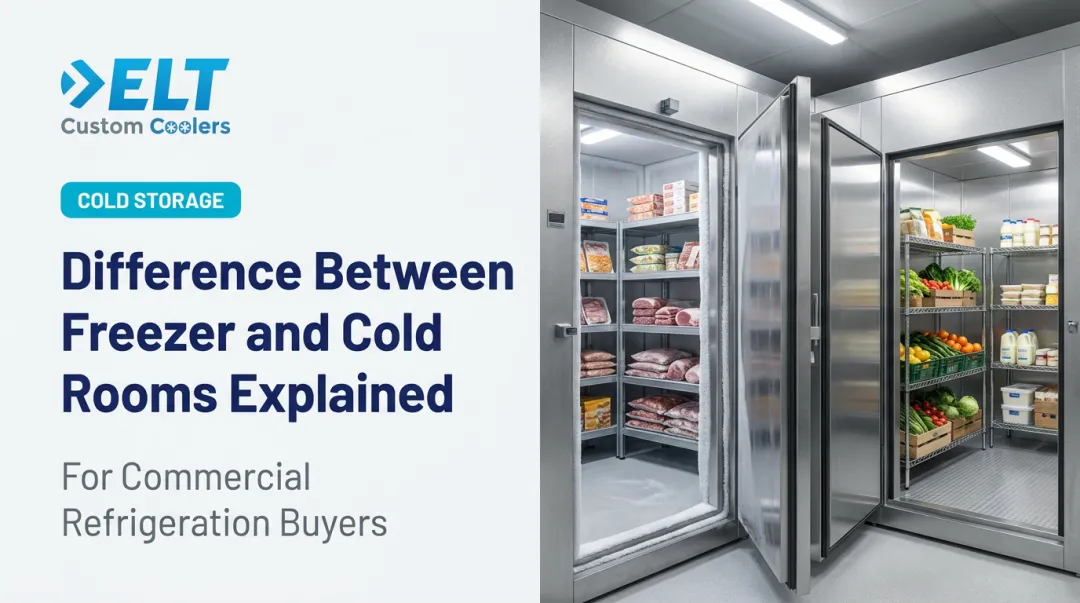
Walk-in coolers operate at 35°F–38°F (~2°C–3°C) and cover the broadest range of fresh storage applications: produce, dairy, beverages, and prepared foods. Modular panel construction lets them fit virtually any footprint.
Door configurations run the full range:
- Standard 36" swing doors for most commercial kitchens
- Large-format sliding systems up to 13' x 10' for high-traffic receiving and prep operations
Walk-In Freezers
Walk-in freezers hold at 0°F to -10°F (-18°C to -23°C), which demands heavier insulation panels and more powerful compressor systems than cooler applications. Freezer doors require heated frames to prevent frost and condensation from breaking the door seal — a standard feature across ELT Custom Coolers' full freezer door lineup.
Blast Chillers and Blast Freezers
Blast equipment solves a specific food safety problem: pulling cooked or received product down to safe storage temperatures fast enough to meet FDA requirements. The FDA mandates that cooked TCS (Temperature Control for Safety) food cool from 135°F to 70°F within two hours, then reach 41°F within six total hours.
For commercial kitchens running HACCP programs, blast chillers and blast freezers are the practical tool that makes those timelines consistently achievable.
Cold Storage Temperature Zones Explained
| Zone | Temperature Range | Typical Products |
|---|---|---|
| Refrigeration | 32°F–40°F (0°C–4°C) | Fresh produce, dairy, prepared foods |
| Frozen storage | 0°F or below (-18°C) | Meats, seafood, frozen prepared foods |
| Deep freeze / blast | -40°F and below | Certain specialty meats, pharmaceutical, research |
The FDA's cold-holding threshold for TCS foods is 41°F or lower; the USDA sets frozen storage at 0°F or below. Running above these thresholds creates food safety and spoilage risk. Running significantly below them wastes energy without any food safety benefit.
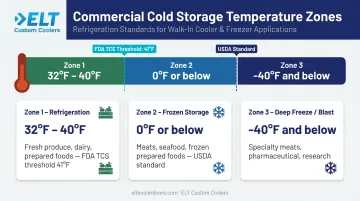
Multi-zone cold rooms — where a single facility maintains separate temperature bands in different sections — have become standard practice in food distribution centers and large-scale processing facilities. Proper zoning reduces cross-contamination risk and lets operators optimize energy use section by section, rather than running the entire facility at the coldest required temperature.
What to Look for When Choosing a Commercial Refrigeration System
Three variables drive every sizing and selection decision:
- Required temperature range — A cooler and a blast freezer are fundamentally different systems; the temperature target determines compressor capacity, refrigerant selection, and insulation specification
- Space volume and load — BTU/kW calculations account for room size, product load, and ambient conditions — undersized systems run continuously and fail early
- Access frequency — Each door opening introduces warm, moist air; high-traffic operations need to account for this in both equipment sizing and door system design
Energy Efficiency Indicators Worth Understanding
- AWEF (Annual Walk-in Energy Factor) — DOE's efficiency metric for walk-in refrigeration systems; higher is better
- MDEC (Maximum Daily Energy Consumption) — DOE's metric for walk-in doors; ask vendors for documented compliance values
- Insulation R-values — Minimum R-25 for coolers, R-32 for freezers; panels exceeding these minimums reduce long-term operating costs
- Inverter/variable-speed compressors — Modulate output to match actual load rather than cycling full-on/full-off, which improves efficiency and reduces wear
- Remote monitoring — Temperature alert systems catch drift before it becomes a loss event
Certifications to Require in Submittals
- NSF/ANSI 7 — Required for food service walk-in equipment
- UL 471 — Covers commercial refrigerators and freezers connected to AC circuits up to 600V
- DOE compliance documentation — Confirm the equipment class, AWEF, and MDEC values are documented
When the door is the component being replaced or upgraded, those same certification standards apply. ELT Custom Coolers manufactures and supplies prehung walk-in cooler and freezer replacement doors with UL Certified, DOE 2017 Compliant, and NSF-approved specifications — built for the restaurant, food service, retail, and cold-storage environments where this equipment gets used hardest.
Frequently Asked Questions
How long do cold rooms last?
A well-built, properly maintained cold room typically lasts 15–25 years; the EPA places commercial refrigeration equipment generally in the 10–20 year range. Longevity hinges on insulation quality, compressor maintenance, and door seal integrity — all of which degrade faster when the system is undersized for its load.
What are the four types of refrigeration?
The four types are vapor-compression (cyclic), absorption, thermoelectric (Peltier/solid-state), and non-cyclic (ice, dry ice, liquid nitrogen). For commercial cold storage — walk-ins, freezers, distribution centers — vapor-compression is the standard by a wide margin due to its efficiency and operating range.
What is the difference between a walk-in cooler and a walk-in freezer?
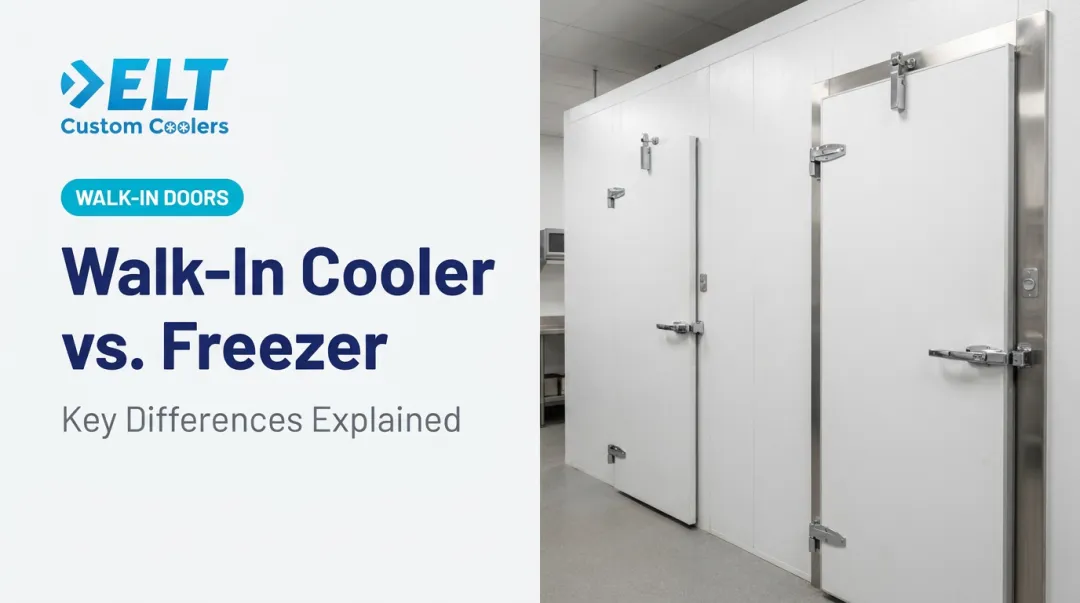
Walk-in coolers hold temperatures above freezing (typically 35°F–38°F) for fresh food storage. Walk-in freezers operate below freezing (typically 0°F to -10°F) for long-term frozen product storage. Freezers require thicker insulation panels, more powerful compressor systems, and heated door frames to prevent frost buildup.
What temperature should commercial cold storage operate at?
Fresh food refrigeration should be held between 32°F and 40°F (FDA cold-holding threshold is 41°F or lower for TCS foods). Frozen storage should be at 0°F or below per USDA guidance. Check FDA and local health department requirements for your specific product category, as TCS foods carry stricter holding thresholds.
What refrigerant is used in commercial walk-in coolers and freezers?
Most modern commercial systems use HFC refrigerants, with R-448A and R-449A now the common replacements for R-404A. The EPA's AIM Act is accelerating a phasedown toward lower-GWP options (R-290, R-717, R-744), so refrigerant selection affects both current compliance and long-term serviceability.
How much energy does a commercial walk-in cooler use?
Consumption varies by size, insulation R-value, door-opening frequency, and ambient temperature — no universal benchmark exists. DOE measures walk-in systems using AWEF and door performance using MDEC; specifying DOE-compliant equipment and high R-value panels is the most reliable path to lower operating costs.