The stakes are real. A seafood distributor running product at 38°F instead of 0°F won't have inventory by the end of the week. A florist storing arrangements in a freezer room will have the same problem, just faster.
This guide breaks down the practical differences — temperature ranges, construction requirements, energy implications, and which unit fits which operation — so you can make the right call before you buy.
Key Takeaways
- Cold rooms maintain 35°F–41°F (1°C–5°C) for fresh products; freezer rooms hold 0°F or below (-18°C) for frozen inventory
- Freezers require R-32 panel insulation vs. R-25 for coolers, plus dedicated floor insulation and heated door frames
- Defrost cycling adds to freezer energy load; coolers don't require it
- Your product type — not your budget — should drive the decision
- Businesses with both fresh and frozen needs can source replacement cooler and freezer doors from a single specialized supplier
Cold Room vs. Freezer Room: At a Glance
| Feature | Cold Room (Walk-In Cooler) | Freezer Room (Walk-In Freezer) |
|---|---|---|
| Temperature | 35°F–41°F (1°C–5°C) | 0°F or below (-18°C or lower) |
| DOE regulatory threshold | Above 32°F | At or below 32°F |
| Storage purpose | Fresh, perishable goods | Frozen products, long-term preservation |
| Wall/ceiling insulation | R-25 minimum | R-32 minimum |
| Floor insulation | Not required | R-28 minimum |
| Door frames | Standard | Heated jamb required |
| Defrost cycling | Not required | Required (typically 2.5–4 cycles/day) |
| Energy demand | Moderate | Higher |
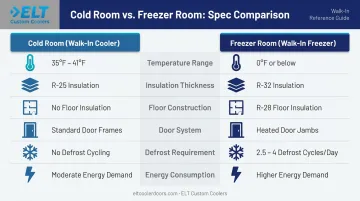
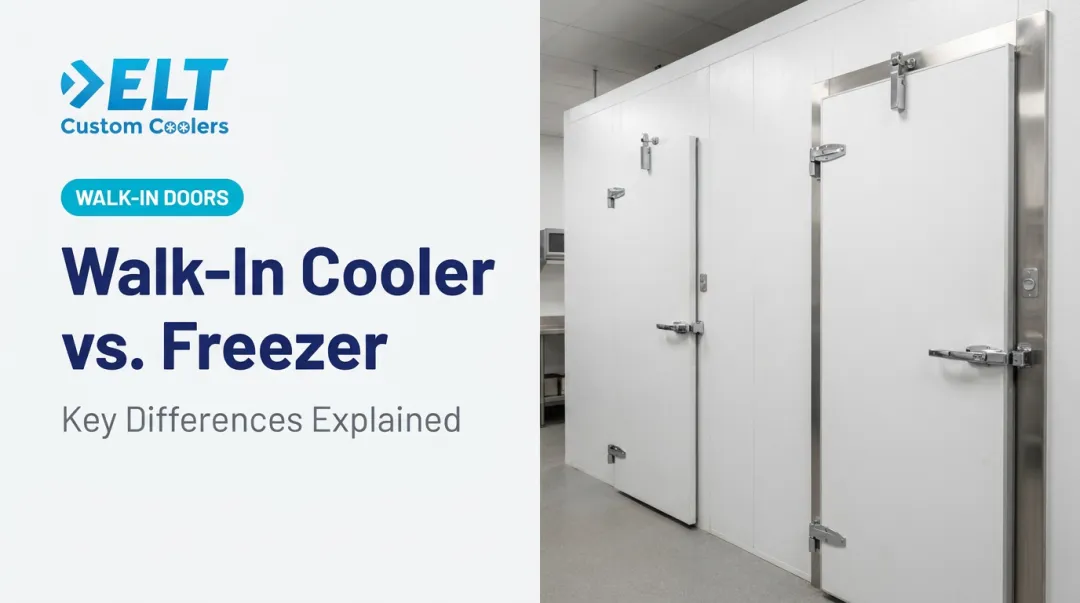
Temperature drives every specification above. Drop below 32°F and the rules change: insulation requirements increase, floor protection becomes mandatory, and door frames must include heated jambs to prevent frost buildup and seal failure. That single threshold is why freezer room doors and cooler room doors are not interchangeable — and why the right replacement door spec matters from the start.
What Is a Cold Room?
Under U.S. DOE regulatory definitions, a cold room — or walk-in cooler — is an enclosed storage space refrigerated above 32°F with less than 3,000 sq ft of chilled storage area. In practice, commercial cold rooms operate between 35°F and 41°F, a range supported by both DOE test conditions and FDA Food Code 2022 requirements for cold holding of time/temperature control for safety (TCS) foods.
Cold rooms slow microbial activity and enzymatic spoilage without the ice crystal formation that damages fresh produce, eggs, or certain pharmaceuticals. That distinction matters: refrigeration above freezing preserves texture and cell structure that sub-zero storage destroys.
Construction Features
- Insulated panels: Closed-cell polyurethane foam meeting R-25 minimum for walls, ceilings, and doors
- Standard refrigeration compressors: Sized for moderate temperature differentials
- Vapor barriers and door seals: Magnetic and double-sweep gaskets maintain temperature and prevent moisture infiltration
- Humidity control: Without active management, fresh produce and florals develop condensation and accelerate mold growth
Who Uses Cold Rooms
- Restaurants: Walk-in coolers hold fresh proteins, produce, and dairy between deliveries
- Grocery and supermarkets: Produce sections, dairy cases, and back-of-house prep storage
- Florists: Flower preservation requires temperatures around 35°F–38°F without freeze risk
- Pharmaceutical distributors: Vaccines and temperature-sensitive medications need above-freezing refrigeration within narrow bands
- Food distribution centers: High-turnover fresh inventory cycles through cooler storage daily
A full-service restaurant receiving morning produce deliveries relies on this directly: the walk-in cooler keeps greens crisp, proteins within safe holding temperatures, and dairy undamaged through the lunch and dinner service cycle.
What Is a Freezer Room?
A freezer room — or walk-in freezer — is an enclosed storage space maintained at or below 32°F, typically targeting 0°F (-18°C) or lower for food safety. FDA guidance confirms that food stored at 0°F remains safe indefinitely from a microbial standpoint, though quality still degrades over time.
Sub-zero temperatures stop enzymatic and microbial activity entirely. For raw proteins, seafood, and frozen prepared foods, even brief temperature excursions into the cooler range can compromise product integrity or cause food safety failures.
Construction Requirements
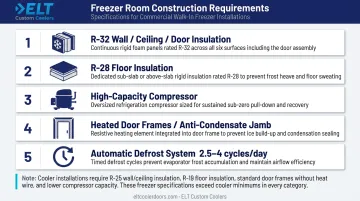
Freezer rooms are more demanding to build than cold rooms, in every dimension:
- R-32 wall, ceiling, and door insulation (vs. R-25 for coolers), per 10 CFR 431.306
- R-28 floor insulation — not required for coolers at all
- Higher-capacity refrigeration compressors to maintain much larger temperature differentials
- Heated door frames: Without anti-condensate heat wire in the jamb, frost accumulates and breaks the door seal
- Automatic defrost systems: DOE test procedures account for defrost cycling at 4 cycles/day for conventional timed systems and 2.5 cycles/day for adaptive defrost — a documented energy driver that coolers simply don't carry
Why Freezer Door Frames Require Built-In Heat
The temperature differential between a -10°F freezer interior and a 70°F ambient exterior causes moisture to condense and freeze directly on door frame surfaces. Without heated jambs, ice buildup will:
- Break the magnetic door gasket seal
- Prevent the door from closing properly
- Create ongoing structural damage through repeated freeze-thaw cycles
ELT Custom Coolers builds replaceable anti-condensate heat wire into every freezer door frame. Cooler door frames omit this element, as the temperature differential doesn't produce the same condensation and freeze risk.
Who Uses Freezer Rooms
- Meat processors and butchers — multi-week raw protein inventory demands consistent sub-zero temps
- Seafood suppliers — thaw-refreeze cycles degrade both quality and food safety compliance
- Frozen food manufacturers — production-side staging before distribution requires sustained 0°F or colder
- Ice cream retailers — frozen dairy must stay frozen at all times per FDA Food Code Section 3-501.11
- Healthcare facilities — biological samples and certain vaccines require validated ultra-cold storage
Cold Room vs. Freezer Room: Which Does Your Business Need?
The decision comes down to four variables: what you store, how long you store it, what your regulatory obligations require, and your total cost of ownership.
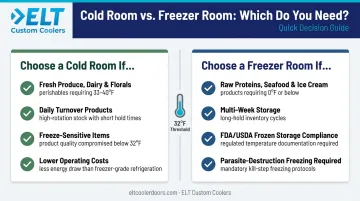
Choose a Cold Room If:
- Your inventory is fresh produce, dairy, ready-to-serve beverages, or florals
- Products turn over daily or every few days
- Your items would be damaged by freezing (leafy greens, eggs, certain medications)
- You need lower upfront and operating costs
Choose a Freezer Room If:
- You store raw proteins, frozen prepared foods, seafood, or ice cream for multi-week periods
- Your products must remain frozen per FDA Food Code or USDA requirements
- You operate a food manufacturing or large-scale distribution facility
- Parasite-destruction freezing is required for certain fish served raw (FDA Food Code specifies -4°F for 168 hours or equivalent validated conditions)
Consider Both If:
Your operation handles fresh and frozen inventory simultaneously — which describes most full-service restaurants, grocery retailers, and food distributors. Separate cooler and freezer units, or partitioned cold storage systems, are the standard solution.
For businesses in this situation, sourcing both door types from a single supplier simplifies procurement and ensures consistent specifications across your cold storage footprint. ELT Custom Coolers carries both walk-in cooler and walk-in freezer doors — including heated-frame freezer configurations — across standard and custom sizes, with financing available through MyCloudFunding.
A quick decision scenario: A mid-size catering company preparing hot and cold menu items for events needs fresh ingredient storage (cooler) and a frozen protein and pastry reserve (freezer). Running both off a single cold room isn't viable; temperature compromises will affect either the fresh or frozen inventory. The right configuration is dedicated units for each function.
To discuss the right configuration for your operation, visit eltcoolerdoors.com or email sales@eltcustomcoolers.com.
Conclusion
Neither a cold room nor a freezer room is the objectively better choice — the right unit is determined by what you're storing and what temperatures those products require. Mismatching unit type to product type means spoilage, compliance risk, and energy waste.
The match is straightforward once you know your requirements:
- Cold room (35°F–41°F): Best for fresh products with daily turnover where freeze damage is a real risk
- Freezer room (0°F or below): Required for sustained sub-zero storage, with appropriate insulation, heated door frames, and defrost systems
Choosing the right unit type from the start — and pairing it with the correct door specs and insulation grade — cuts operating costs, prevents spoilage, and keeps you compliant through food safety inspections for years ahead.
Frequently Asked Questions
What are freezer rooms called?
Freezer rooms are also referred to as walk-in freezers, frozen storage rooms, or cold storage freezers depending on the industry. In U.S. regulatory language, "walk-in freezer" is the standard term — defined by the DOE as an enclosed walk-in space maintained at or below 32°F with less than 3,000 sq ft of chilled storage area.
Are there cameras in freezer rooms?
Cameras aren't a standard regulatory requirement, but many commercial freezer rooms are equipped with security cameras and temperature monitoring systems. This is especially common in large food service operations, pharmaceutical storage, and distribution facilities where inventory management, safety compliance, and theft prevention are priorities.
What is the difference between a walk-in cooler and a cold room?
In practice, both terms describe the same thing: an enclosed, walk-in refrigerated space maintained above freezing for fresh product storage. "Walk-in cooler" is the standard U.S. industry and regulatory term; "cold room" is more common internationally and in general commercial use.
Can a cold room be converted into a freezer room?
Conversion is possible but requires significant retrofitting — upgraded insulation (R-32 panels, R-28 floor), a higher-capacity freezer compressor, frost-resistant door seals, heated jambs, and a defrost system. Most manufacturers recommend against it; a purpose-built freezer room is the preferred approach.
What temperature should a cold room be set to?
Most cold rooms are set between 35°F and 41°F (1°C–5°C) for general fresh food storage. The FDA Food Code requires TCS foods to be held at 41°F or below. Dairy and raw proteins are best stored closer to 35°F; some produce tolerates slightly warmer settings depending on the commodity.
How much more does a walk-in freezer cost to operate than a walk-in cooler?
Freezer systems consistently cost more to operate than coolers — they must hold temperatures roughly 45°F–50°F lower (DOE test conditions: -10°F vs. 35°F), require thicker insulation, and run defrost cycles multiple times daily. The exact dollar difference depends on your equipment specs and local utility rates.