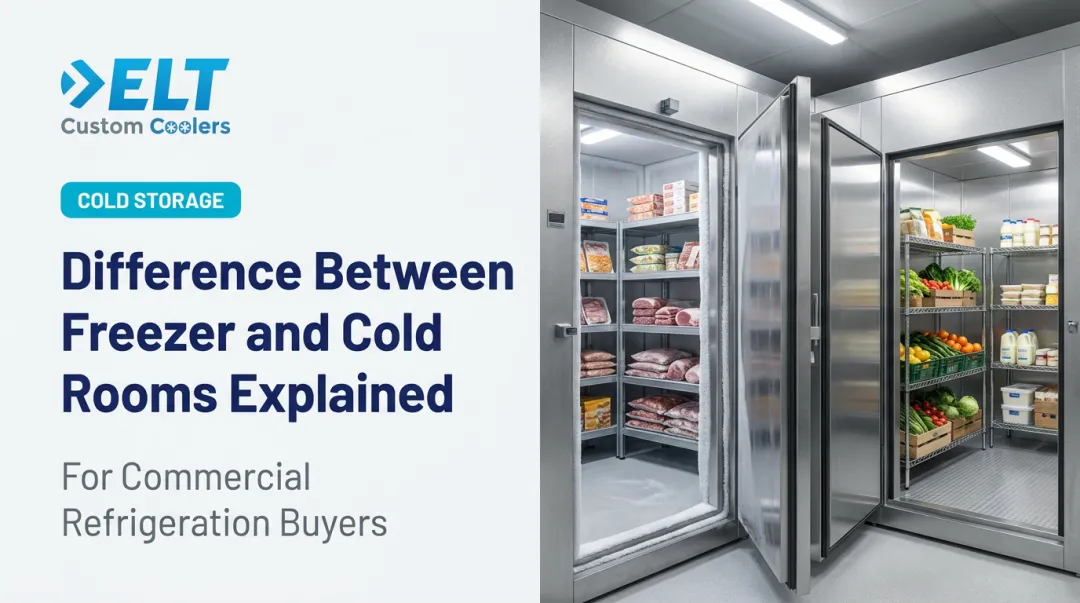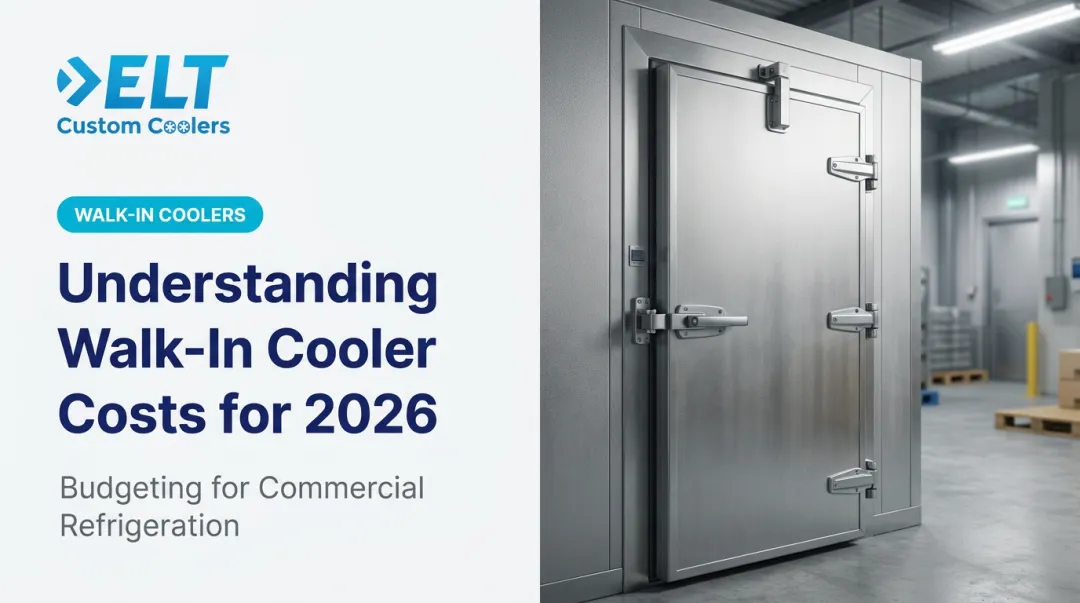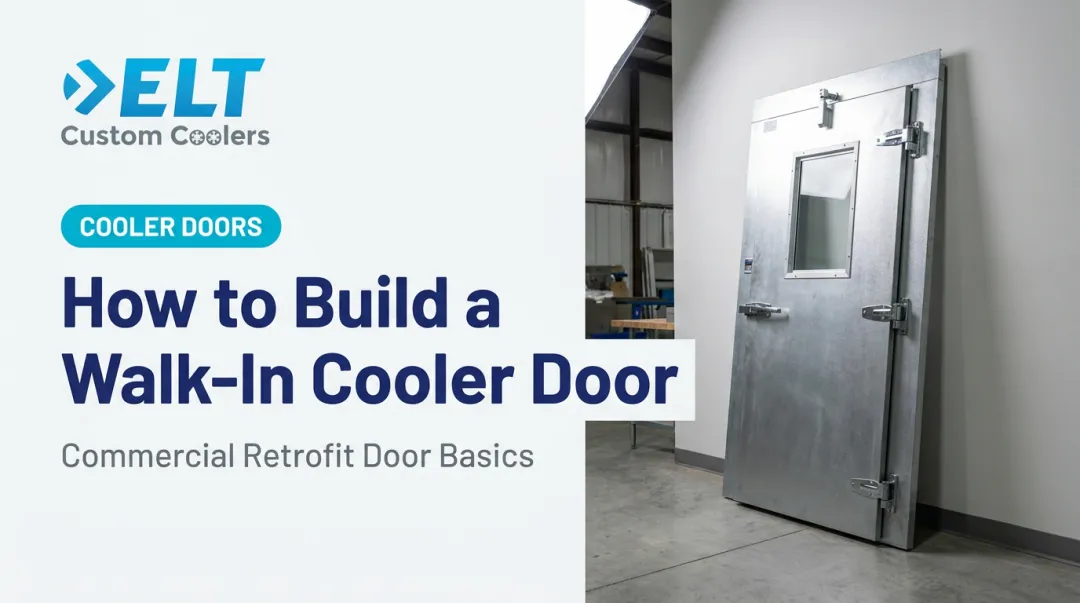
The decision goes deeper than temperature. It affects insulation requirements, door construction, floor specifications, and long-term operating costs. This guide breaks down the key differences across temperature ranges, construction standards, energy demands, and use cases — then helps you determine which unit fits your operation.
Key Takeaways
- Walk-in coolers target 35°F–41°F; freezers operate at 0°F and below — that temperature gap determines every structural and mechanical difference between them
- Freezers require higher R-value insulation, insulated floors, and heated door frames
- DOE mandates R-25 minimum for cooler walls and R-32 for freezer walls
- A cooler cannot be "turned down" to function as a freezer — the insulation, refrigeration system, and floor are not built for sub-zero temps
- Door spec, frame type, and insulation rating all differ between coolers and freezers — confirm the correct configuration before ordering replacement components
Walk-In Cooler vs. Walk-In Freezer: Quick Comparison
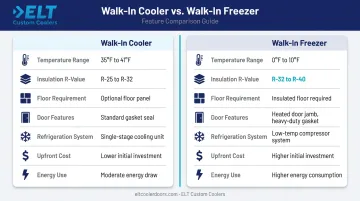
| Feature | Walk-In Cooler | Walk-In Freezer |
|---|---|---|
| Temperature Range | 35°F–41°F operating target | 0°F and below |
| Insulation (Federal Minimum) | R-25 walls, ceilings, doors | R-32 walls, ceilings, doors |
| Floor Requirement | Existing concrete slab typically sufficient | Insulated floor panel required (R-28 minimum) |
| Door Features | Standard gasketed door | Heated jamb, anti-condensate wire, pressure relief port |
| Refrigeration System | Standard medium-temperature components | Heavy-duty low-temperature condensing unit |
| Upfront Cost | Lower | Higher |
| Energy Consumption | Lower | Higher — larger temperature differential to overcome |
Temperature Ranges
FDA Food Code 2022, Section 3-501.16(A)(2) requires refrigerated Time/Temperature Control for Safety (TCS) food to be held at 41°F or less. Operators typically target the mid-to-high 30s to maintain a safety buffer below that ceiling.
Walk-in freezers are benchmarked at 0°F or below, per USDA food safety guidance — at which point bacterial activity stops and frozen food can be stored indefinitely from a safety standpoint, though quality still degrades over time. Some applications, particularly ice cream, operate closer to -5°F for product quality reasons.
Insulation and Panel Construction
DOE's 10 CFR Part 431 Subpart R sets the federal minimums: R-25 for cooler walls, ceilings, and doors; R-32 for freezer walls, ceilings, and doors; and R-28 for freezer floors. DOE regulates R-value, not panel thickness — though 4-inch polyurethane panels are the industry norm for both cooler and freezer applications.
ELT Custom Coolers' door products reflect these standards directly: cooler replacement doors use R-20 closed-cell insulation cores, while freezer doors are built to R-32 — a 60% increase in thermal resistance built for sub-zero operating conditions.
Floor and Door Requirements
Coolers can typically be installed on an existing concrete slab. Freezers cannot — without an insulated floor panel (R-28 minimum), sub-zero temperatures transfer through the slab into the subgrade, freezing soil moisture and forming expanding ice lenses.
One documented refrigerated warehouse case recorded floor deformation of more than one foot at the center of the structure before the issue was identified.
The door assembly introduces its own set of freezer-specific requirements. ELT's walk-in freezer doors address these through:
- Replaceable anti-condensate heat wire in the door frame (a freezer-only feature)
- Dual-gasket systems combining magnetic and double-sweep gaskets
- Heated jamb frames on sliding freezer configurations
All three features work together to prevent gasket icing and ensure the door can be opened safely after extended freeze cycles.
What Is a Walk-In Cooler?
A walk-in cooler is a large, room-sized refrigerated enclosure that maintains temperatures in the 35°F–41°F range — cold enough to slow bacterial growth and preserve perishable goods, but above freezing so product texture and nutritional value aren't compromised.
Construction typically involves modular cam-lock panel systems with high R-value insulation, gasketed doors, and configurable interior shelving. Because cooler panels don't need to handle sub-zero stress, the refrigeration system is simpler and less expensive than what a freezer requires.
ELT Custom Coolers offers walk-in cooler replacement doors from 30" to 60" wide and 78" to 130" tall, across plug frames, standard jamb frames, and sliding door configurations up to 12'x12'. That range covers everything from a small restaurant back-of-house cooler to a large grocery stockroom.
Walk-In Cooler Use Cases
Walk-in coolers are the standard choice across a wide range of commercial operations:
- Restaurants and ghost kitchens — fresh produce, prepped ingredients, dairy, sauces
- Grocery and convenience stores — beverages, packaged deli, dairy cases
- Breweries and wineries — fermentation temperature control, finished product storage
- Floral distributors — cut flowers requiring cool, humid storage
- Healthcare and hospitality — hospital kitchens, hotel catering, corporate cafeterias
That variety of use cases also means energy decisions carry real weight. Refrigeration accounts for 15% of energy consumption in food-service buildings — the second-largest energy end-use in that sector, according to the EIA's Commercial Buildings Energy Consumption Survey. Keeping cooler temperatures properly calibrated, not running colder than necessary, directly affects where that spend lands.
What Is a Walk-In Freezer?
A walk-in freezer is a heavy-duty insulated storage room engineered to maintain temperatures at 0°F and below, creating a deep-freeze environment that halts bacterial activity entirely and enables long-term product preservation.
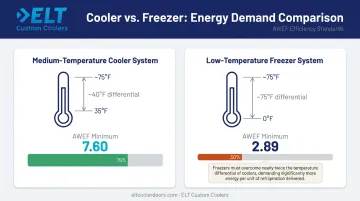
The construction demands are considerably higher than a cooler's. The refrigeration system must overcome a much larger temperature differential between ambient and target storage temperature, requiring more powerful low-temperature condensing units. DOE tracks this through the Annual Walk-in Energy Factor (AWEF) — the 2017 federal rule set minimum AWEF values at 7.60 for medium-temperature (cooler) refrigeration systems and 2.89 for low-temperature (freezer) systems, reflecting the substantially heavier workload freezer equipment carries.
Doors on walk-in freezers need features that cooler doors don't. ELT's freezer door line addresses this directly: anti-condensate heat wire prevents the door gasket from freezing shut during normal operation; heated jamb sandwich frames on sliding freezer doors (available up to 8'x12') keep the frame clear of ice buildup; and dual-gasket systems maintain a tight, frost-resistant seal through repeated open/close cycles.
Pressure relief ports equalize air pressure when doors are opened and closed. Without them, the pressure differential in a cold, sealed environment can make doors difficult or impossible to open.
Walk-In Freezer Use Cases
Walk-in freezers are non-negotiable for bulk inventory that needs a solid frozen state:
- Full-service restaurants — bulk proteins, frozen prepared components
- Seafood distributors and meat processors — extended shelf life for high-value perishables
- Ice cream and frozen dessert operations — often requiring temperatures near -5°F
- Cold storage warehouses and 3PLs — long-term frozen inventory management
- Food commissaries — batch-prepared meals and frozen entrees
For any of these operations, a freezer failure is an immediate crisis. FDA guidance notes that a full freezer holds temperature for approximately 48 hours with doors closed; a half-full freezer holds for about 24 hours. After that window, inventory decisions become costly.
Walk-In Cooler vs. Walk-In Freezer: Which One Do You Need?
The decision comes down to what you store, how often you access it, and what your space and budget allow.
Choose a Walk-In Cooler If:
- Your inventory is primarily fresh produce, dairy, beverages, or flowers
- You need frequent, high-volume access throughout the day
- You're working with a tighter upfront budget or limited utility capacity
- Your products require temperatures above freezing to preserve texture and quality
Choose a Walk-In Freezer If:
- You handle bulk frozen proteins, seafood, pre-prepared frozen meals, or ice cream
- You need to extend product shelf life beyond a few days
- Your operation runs a commissary, distribution, or batch-production model
- Regulatory requirements for your product category mandate frozen storage
When to Consider a Combo Unit
Businesses that store both fresh and frozen inventory should evaluate walk-in cooler/freezer combo units — partitioned structures sharing one footprint, with separate refrigeration systems and doors for each section. For operations with limited floor space, a combo unit avoids the cost and square footage of two standalone installations.
If you're unsure which configuration fits your operation, ELT Custom Coolers can help — from selecting a replacement cooler door to specifying a heated-jamb freezer door for a new installation. Contact their team at sales@eltcustomcoolers.com.
Why You Can't Just "Turn Down" a Cooler
Many operators assume a walk-in cooler can simply be "turned down" to function as a freezer. It can't. Cooler doors carry lower insulation R-values (R-20 vs. R-32), lack heated frames and anti-condensate wire, and the floor is uninsulated — not rated for sub-zero heat transfer.
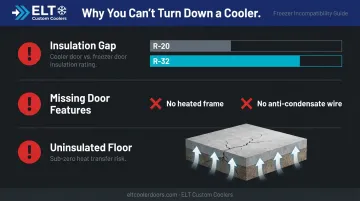
Running a cooler at freezer temperatures risks frost heave beneath the unit, equipment failure outside its rated operating range, and food safety violations if product doesn't reach or hold required frozen temperatures.
Conclusion
There's no universal winner here — the right unit depends entirely on what you're storing. Coolers protect fresh inventory efficiently, at lower cost and with less energy overhead. Freezers deliver the deep-freeze environment that long-term preservation of frozen goods requires. Businesses with both needs should look seriously at combo configurations instead of purchasing two separate units.
Specifying the right unit from the start prevents food safety violations, unnecessary energy costs, and equipment running outside its design range. For replacement doors, frames, gaskets, or hardware for your walk-in cooler or freezer, contact ELT Custom Coolers at sales@eltcustomcoolers.com.
Frequently Asked Questions
Can I use a cooler as a freezer?
No. A standard walk-in cooler's insulation panels, refrigeration system, and floor construction are not rated for sub-zero temperatures. Operating it below its designed range risks equipment failure, frost heave damage beneath the unit, and food safety non-compliance.
What foods should not be refrigerated?
Certain foods degrade faster in refrigeration due to chilling injury or moisture damage. Common examples include:
- Tomatoes, potatoes, onions, and garlic
- Bananas and unripe avocados
- Honey, bread, and coffee
- Winter squash and fresh basil
Store these at room temperature in a dry environment.
What temperature should a walk-in cooler be set at?
Per FDA Food Code 2022, TCS foods must be held at 41°F or less. Most operators target 38°F as a practical balance between food safety compliance and energy efficiency, with enough buffer to avoid accidental product freeze.
Do walk-in freezers require an insulated floor?
Yes — always. Without an insulated floor panel (DOE minimum R-28), sub-zero temperatures transfer through the concrete slab into the subgrade, freezing soil moisture and causing frost heave that can deform and crack the floor over time.
What is a walk-in cooler/freezer combo unit?
A combo unit is a single walk-in structure partitioned into two sections — one held at cooler temperatures, one at freezer temperatures — each with its own door and refrigeration system. It's a space-efficient option for businesses that need both temperature zones without installing two separate units.
How much more energy does a walk-in freezer use compared to a cooler?
Freezers consistently consume more energy because they maintain a much larger temperature differential against ambient conditions. DOE component standards reflect this: minimum AWEF for medium-temperature (cooler) systems is 7.60, versus 2.89 for low-temperature (freezer) systems. Actual cost differences vary by unit size, door traffic, and local utility rates.