
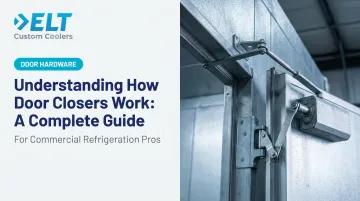
That's when problems compound quickly. A malfunctioning closer on a fire door creates a code violation. On a walk-in cooler, it drives up energy costs and risks food safety compliance. Even in a standard office, a poorly adjusted closer accelerates wear on hinges, strikes, and door frames.
This guide breaks down exactly how a door closer works mechanically — the spring, the hydraulics, the three adjustable valves — and where correct specification and adjustment matter most in commercial settings.
Key Takeaways
- A door closer compresses a spring during opening, then uses hydraulic resistance to control the door's return
- Three adjustable valves govern distinct phases: sweep speed, latch speed, and back check
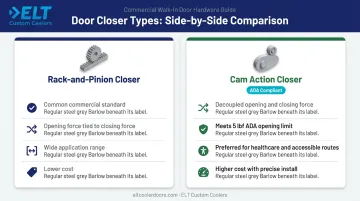
- Rack-and-pinion closers are standard in commercial settings; cam-action closers prioritize low opening force
- Federal regulations under 10 CFR Part 431 require automatic door closers on walk-in coolers and freezers
- Oil leaking from a closer means replacement — not adjustment
What Is a Door Closer?
A door closer is a mechanical device that regulates the speed and force of a door's swing, returning it to a fully closed and latched position automatically after each use — without slamming.
Doors left open or allowed to slam cause energy loss, noise disruption, fire safety failures, hardware wear, and security vulnerabilities. One passive mechanism — no electricity required — handles all of it by storing energy in a spring during opening and metering its release through hydraulic resistance on the return.
What a Door Closer Is Not
Specifying the right hardware starts with understanding what a closer doesn't do:
- A closer controls return speed — it does not lock the door or restrict entry
- A closer returns the door to shut — it cannot hold the door open (that's a door stop or hold-open arm)
- A closer manages the closing cycle only — electrically powered automatic operators (ANSI/BHMA A156.19) handle both opening and closing on command; a closer plays no role in powered operation
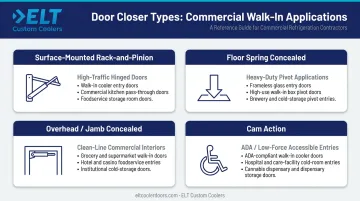
Main Types at a Glance
| Type | Common Applications |
|---|---|
| Surface-mounted hydraulic (rack-and-pinion) | General commercial, institutional |
| Floor spring (concealed) | Heavy glass doors, architectural entries |
| Overhead/jamb concealed | Aesthetic or vandal-resistant environments |
| Cam action | Accessibility routes, healthcare, public buildings |
The internal working principle — spring energy storage plus hydraulic resistance — is consistent across all four types. What varies is where the mechanism mounts and how the arm geometry connects to the door leaf, which directly affects backcheck behavior and closing torque.
How Does a Door Closer Work?
A door closer operates through a defined mechanical sequence: energy storage during opening, controlled energy release during closing, and speed regulation throughout. Each phase is distinct and independently adjustable.
Storing Energy When the Door Opens
When someone pushes or pulls the door open, the arm rotates and engages the internal mechanism. In the most common commercial design — the hydraulic rack-and-pinion closer — this motion drives a toothed rack that turns a pinion gear, pushing a piston through a hydraulic chamber.
That piston movement compresses or tensions an internal spring, storing the mechanical energy that will return the door to its closed position. The force required to open the door reflects the spring tension setting, also called the power or size rating.
Spring compression begins at the first degree of door swing. There is no threshold — the closer starts storing energy immediately.
Releasing Energy to Close the Door
Once released, the compressed spring pushes the piston back through the hydraulic fluid-filled chamber, rotating the pinion and arm and physically pulling the door toward the closed position.
The hydraulic fluid is what prevents the spring from slamming the door shut at full force. As the piston moves, fluid is forced through narrow internal channels controlled by throttle valves. That resistance slows and smooths the door's movement.
A one-way check valve manages the fluid flow direction:
- During opening: the valve allows fluid to pass freely, keeping opening resistance manageable
- During closing: the valve closes, forcing fluid only through the adjustable throttle valves — creating controlled, graduated resistance
Speed Regulation: The Three Adjustable Valves
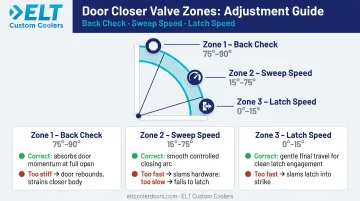
Most commercial closers include small adjustment screws on the closer body that control hydraulic fluid flow at specific points in the door's travel. These are the primary tuning tools.
Sweep speed (also called main or closing speed) controls the door's movement from fully open to approximately 10–15 degrees from closed. Yale manufacturer documentation specifies this as the 120 to 15-degree range. LCN specifies a normal closing time from 90 degrees of 5 to 7 seconds, split between sweep and latch phases.
Latch speed controls the final 10–15 degrees of travel. It is typically set faster than sweep speed to ensure the latch engages positively. Too slow here is one of the most common causes of doors that appear closed but haven't latched — a critical failure point for fire doors and cold storage.
Back check limits how fast the door can be pushed open. Norton's 7500/7700 Series documentation specifies back check engagement beginning at approximately 75 degrees of opening. This protects the door, frame, and adjacent walls from impact damage during high-traffic use.
Why correct adjustment matters:
- Sweep too fast: the door slams and hardware stress accumulates over time
- Sweep too slow: the door loses momentum before fully latching
- Latch speed too slow: the door sits ajar without securing
- No back check: forceful opening damages walls, frames, and hinges
Types of Door Closers
Surface-Mounted Rack-and-Pinion
The dominant commercial type. Mounted on the door face or frame, these use a gear-driven piston system that delivers, as ASSA ABLOY's product documentation states, "smooth constant control of the door through its full opening and closing cycle."
The Norton 1600 Series is a representative example — an ANSI/BHMA Grade 1 closer for interior or exterior doors across a wide range of commercial applications. Grade 1 certification requires 2,000,000 cycles of durability testing under ANSI/BHMA A156.4-2024, the governing American standard for door closers.
Concealed Closers
Three concealed configurations exist, all operating on the same hydraulic principle but hidden from view:
- Floor springs — installed beneath the door pivot point; suited for heavy glass doors and aesthetically sensitive entrances (dormakaba BTS80 Series)
- Overhead concealed — mounted inside the door or frame header; arm and track are hidden when the door is closed
- Jamb/in-frame — mortised into the door and frame for complete visual concealment; suited for virtually any door and frame combination
Cam Action Closers
Rack-and-pinion covers most applications, but cam action closers solve a specific compliance problem. Instead of gears, they use a cam disc and roller follower, which decouples opening resistance from closing force — delivering easy pull with reliable latching.
The U.S. Access Board sets a maximum 5 lbf opening force for accessible interior doors under ADA Section 404.2.9. Standard rack-and-pinion closers adjusted to hit that limit often can't generate enough closing force to reliably latch fire-rated doors. Cam action closers solve this directly.
SARGENT's 422 Series, for example, is engineered to "make doors easy to open while maintaining enough force to close doors securely." They cost more and require precise installation, but for hospitals, care facilities, and public buildings on accessible routes, they're the correct specification.
Where Door Closers Matter Most
Fire-Rated Door Assemblies
NFPA 80 mandates that fire doors must be "kept closed and latched or arranged to be automatic closing during the time of a fire." IBC Section 716.2.6 requires closures installed per NFPA 80 on all fire door assemblies. Blocking or wedging fire doors open is explicitly prohibited.
Closers used on fire-rated assemblies must be UL Certified and listed for the specific fire rating of the door. Undersized or incorrectly rated closers are a compliance failure, not just a maintenance issue.
Walk-In Coolers and Freezers
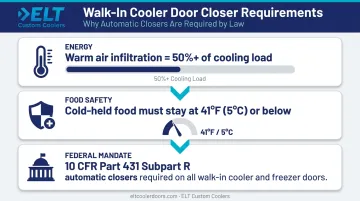
Cold storage is the most consequential application for door closers. Federal regulations under 10 CFR Part 431 Subpart R require that walk-in coolers and freezers have automatic door closers that firmly close all doors that have been closed to within 1 inch of full closure.
The compliance and energy stakes span multiple regulatory frameworks:
- Energy: A 2018 DOE/NREL-funded study found warm air infiltration accounts for over 50% of a walk-in cooler's cooling load — an improperly closing door doesn't waste energy incrementally, it undermines the refrigeration system's ability to maintain temperature altogether.
- Food safety: FDA Food Code 2022 requires cold-held food be maintained at 41°F (5°C) or below. While the Food Code doesn't explicitly mandate self-closing doors, maintaining that threshold depends on door integrity.
- Federal mandate: 10 CFR Part 431 Subpart R applies directly to walk-in cooler and freezer door closer performance requirements.
ELT Custom Coolers builds door closers into their walk-in cooler and freezer door assemblies as standard hardware, included on prehung doors across the product line to ensure the door seals completely after use.
The catalog also carries the Kason 1094 SureClose™ hydraulic door closer as a standalone component: a gas-loaded hydraulic cylinder life-cycle tested to over 500,000 closures, with adjustable mounting slots to compensate for door sag — one of the most common failure points in high-traffic cold storage environments.
Conclusion
A door closer is a hydraulic energy-storage-and-release system. It captures the force used to open a door in a compressed spring, then releases that energy through calibrated hydraulic resistance. The three adjustable valves — sweep speed, latch speed, and back check — give operators precise control over each phase of the door's movement.
For facility managers and contractors, understanding this mechanism makes diagnosis simple. Common symptoms point directly to their cause:
- A slamming door signals a sweep speed problem
- A door that sits ajar points to latch speed or spring tension
- A door leaking fluid needs replacement, not adjustment
In commercial cold storage, a single improperly closing door can account for a measurable share of the refrigeration load. The right closer, properly specified and adjusted, directly affects energy costs, food safety compliance, and how long your refrigeration equipment lasts.
Frequently Asked Questions
How does a door closer work?
A door closer stores the energy used to open a door in a compressed internal spring, then uses hydraulic fluid resistance to control the speed and force of the door returning to its closed position. This prevents slamming while ensuring the latch engages fully every time.
What are the three adjustments on a door closer?
Most hydraulic door closers have three adjustable valves:
- Sweep speed — controls closing speed from fully open to roughly 10–15 degrees from closed
- Latch speed — controls the final 10–15 degrees to ensure positive latch engagement
- Back check — limits how fast the door can be pushed open to prevent impact damage
What are the main types of door closers?
Door closers fall into three primary categories:
- Surface-mounted hydraulic rack-and-pinion — the most common type in commercial settings
- Concealed closers — floor spring, overhead, or jamb-mounted for aesthetic applications
- Cam action closers — lower opening resistance, preferred where ADA compliance is a priority
What is the difference between sweep speed and latch speed?
Sweep speed governs how fast the door travels through the majority of its closing arc. Latch speed controls only the last few degrees. Latch speed is typically set faster than sweep speed so the door positively engages the latch — a slow latch speed is a common cause of doors that appear closed but haven't secured.
Do walk-in cooler and freezer doors need door closers?
Yes — and it's a federal requirement. U.S. regulations under 10 CFR Part 431 mandate automatic door closers on walk-in coolers and freezers manufactured after January 1, 2009. Beyond compliance, an improperly closing door can account for over half of a cooler's total cooling load, directly increasing energy costs and pushing product temperatures above safe holding ranges.
How do I know if my door closer needs adjustment or replacement?
Adjust if the door slams (sweep speed too fast), fails to latch (latch speed too slow or spring tension too low), or swings open hard (back check too loose). If hydraulic fluid is visibly leaking from the closer body, internal seals have failed — replacement is required, not adjustment.