Published product listings show equipment ranging from around $5,000 for a compact prefab unit to well over $40,000 for a large custom installation. Layer in rising construction costs — Mortenson's Q4 2025 Construction Cost Index reported year-over-year labor costs up 5.6% and materials up 9.1% — and budgeting without a clear framework is a real risk.
This guide breaks down 2026 pricing tiers, the key cost drivers, what's included (and what isn't) in a typical quote, and how to build a realistic budget for your specific operation.
Key Takeaways
- Walk-in cooler costs range from roughly $5,000 for a small unit to $40,000+ for large or custom builds
- A working benchmark: $100–$150 per square foot all-in, covering the unit, insulation panels, and basic installation
- Size, refrigeration system type, and insulation quality are the biggest cost drivers — insulation thickness alone (2" vs. 4" panels) can shift your budget by 15–20%
- Small cafes and convenience stores typically land at the lower end; breweries, large restaurants, and cold-storage warehouses should plan for the higher range
- Higher upfront investment in energy efficiency and insulation pays back through lower utility and maintenance costs over time
How Much Does a Walk-In Cooler Cost in 2026?
Walk-in coolers don't have a catalog price. The same "8x10 cooler" can cost $14,000 or $22,000 depending on the refrigeration system, insulation spec, and what your site requires to make it functional.
Buyers who focus only on equipment-only quotes often face sticker shock once installation, electrical work, and site prep get added to the invoice. Getting those line items early is what separates a clean project from a costly surprise.
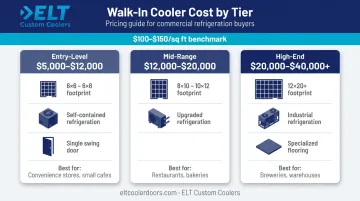
A practical starting point: $100–$150 per square foot as an all-in benchmark. That typically covers the unit, insulation panels, and standard installation, but not custom features, specialty flooring, or electrical panel upgrades.
Entry-Level / Small Units ($5,000–$12,000)
Prefab units in the 6'x6' to 6'x8' range typically include:
- Self-contained refrigeration system
- Standard insulation panels
- Single swing door
- Basic installation on a straightforward site
Published distributor listings for 6x6 self-contained units show prices in the $9,588–$13,985 range depending on brand and spec.
Best for: Convenience stores, small floral shops, and startup cafes with limited inventory volume and tight space constraints.
Mid-Range / Standard Commercial Units ($12,000–$20,000)
Mid-size configurations (8'x10' to 10'x12') typically include:
- More capable refrigeration systems
- Upgraded insulation panels
- Moderate installation complexity
As a real-world reference point, 8x10 self-contained units from major distributors list in the $14,610–$16,603 range — before installation costs.
Best for: Restaurants, bakeries, and mid-size grocery operations that need reliable temperature control and some configuration flexibility.
High-End / Large or Custom Units ($20,000–$40,000+)
Large-footprint builds (12'x20' and above) or fully custom configurations typically include:
- Industrial-grade refrigeration systems
- High-R-value polyurethane panels
- Specialized flooring and advanced temperature controls
- Complex installation involving site prep and electrical upgrades
Best for: Large restaurants, warehouses, breweries, food processing facilities, and operations requiring precise climate control or heavy daily use.
Key Factors That Affect Walk-In Cooler Cost
Understanding what drives price differences helps you evaluate quotes that might seem inconsistent and avoid being caught off guard by the final number.
Size and Footprint
More square footage means more insulated panels, a higher-capacity refrigeration system, and longer installation time. Cost-per-square-foot pricing scales non-linearly — larger units sometimes have a lower per-square-foot rate but a much higher total cost. Buying slightly larger than current needs can be cost-effective long-term, but over-sizing adds unnecessary upfront cost and ongoing energy expense.
Type of Refrigeration System
This is one of the most significant variables in the quote.
- Self-contained systems mount the condenser directly on the unit — simpler setup, lower install cost, but they add heat to the surrounding space
- Remote systems locate the condenser outside or on the roof — quieter, more efficient in warm kitchens, but they add several thousand dollars to installation
For context: one manufacturer's 8x10 unit lists remote refrigeration at $4,752 and self-contained at $7,487 — a $2,735 difference on that specific product. Undersizing refrigeration capacity for the cooler's volume is a common mistake that leads to equipment strain and early failures.
Insulation Material and Panel Thickness
Panel foam core matters more than most buyers realize:
- Polyurethane panels: Higher R-value (standard 4-inch panels typically reach R-32 per manufacturer specs from Norlake and Master-Bilt), better long-term efficiency, higher upfront cost
- Polystyrene panels: Lower upfront cost, lighter weight, but lower insulating performance — and less-efficient insulation may require a larger refrigeration system to compensate, adding cost elsewhere
- DOE/EISA requirements set minimums of R-25 for coolers and R-32 for freezers
4-inch panels are standard for most cooler applications. Better panels reduce monthly energy costs across the unit's entire 15–20 year lifespan — insulation is a long-term operating cost decision, not just a line item.
Level of Customization
Off-the-shelf prefab units deliver in roughly 1–6 weeks at lower cost. Custom-built units tailored to specific dimensions or operational requirements take 10–12 weeks and cost more.
A few customization factors and their cost implications:
- Outdoor installation: Typically adds 10–15% for weatherproofing
- Cooler-freezer combination unit: Can actually save 10–15% compared to two separate units
- Special finishes or non-standard dimensions: Add a percentage to the base price depending on complexity
Installation and Site Requirements
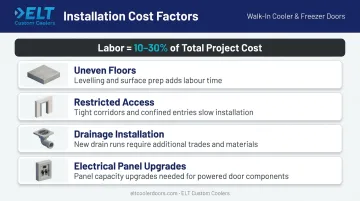
Labor typically represents 10–30% of total project cost — but complex sites can push that higher. Factors that add cost:
- Uneven floors requiring a concrete pad
- Narrow or restricted access points
- Drainage system installation
- Electrical panel upgrades if existing service can't support the load
New construction on an open site installs faster and cheaper than retrofitting into a cramped existing building. Request a site assessment from your installer before locking in a budget — retrofits into existing buildings frequently uncover costs that don't appear in standard quotes.
Full Cost Breakdown: Beyond the Purchase Price
The equipment quote is only one piece of the actual investment. Buyers who focus only on the unit price are routinely surprised by the true all-in cost.
Initial Purchase (One-Time)
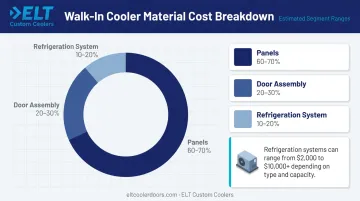
The cooler unit itself — panels, door assembly, and refrigeration system. As a rough breakdown of material costs:
- Panels: 60–70% of material cost
- Door assembly: 20–30%
- Refrigeration system: 10–20% (though the system alone can range from $2,000 to $10,000+ depending on capacity and type)
Installation and Setup (One-Time)
Professional labor covers assembly, refrigerant charging, electrical wiring to a dedicated circuit, system testing, and cleanup. Standard installation jobs typically run $2,000–$7,000, with complex sites pushing higher. Electrical upgrades, concrete pads, and drainage work are separate line items that can add $1,000–$4,000+.
Operating Costs (Monthly)
Walk-in coolers run 16–18 hours per day. Using EIA's March 2026 commercial electricity average of $0.1364/kWh, a standard 8x8 or 8x10 unit runs $150–$165 per month based on recalculated figures from U.S. Cooler's operating data. Your actual cost shifts with unit size, refrigeration efficiency, door usage frequency, and local rates.
These recurring monthly costs are where smart equipment choices pay off over time.
Upgrades that reduce this recurring expense:
- High-R-value insulation panels
- LED lighting (U.S. Cooler cites 68–85% energy savings vs. fluorescent)
- Energy-efficient refrigeration systems meeting DOE's updated standards (new compliance requirements take effect December 2028)
Maintenance and Repairs (Annual)
Routine preventive maintenance — coil cleaning, door seal inspection, refrigerant level checks — is the single most controllable annual cost. Skip it, and you're looking at compressor strain, inflated energy bills, and emergency repair calls.
Compressor replacement alone runs from several hundred dollars for parts to $3,000–$5,000+ for medium-capacity units including labor.
Upgrades and Replacements (Periodic)
Over a 15–20 year lifespan, expect to replace doors, gaskets, door hardware, and refrigeration components at least once. Smart temperature monitoring systems and upgraded lighting are additional periodic investments — both reduce operating costs and make health department inspections easier to pass.
Budget vs. Premium Walk-In Coolers: What's the Real Difference?
The gap between a budget unit and a premium one goes beyond sticker price. It shows up in daily performance and total cost of ownership across years of operation.
| Dimension | Budget Unit | Premium Unit |
|---|---|---|
| Temperature consistency | May fluctuate under heavy load | Holds tight tolerances consistently |
| Durability | Hardware and panels wear faster with heavy use | Built for daily commercial demands |
| Maintenance frequency | More service calls, shorter component life | Less frequent intervention needed |
| 10-year ownership cost | Lower upfront, higher operating + repair costs | Higher upfront, lower ongoing costs |
| Certifications | May lack independent verification | UL Listed, NSF approved, DOE compliant |
Certifications signal more than compliance. NSF/ANSI 7 establishes food protection and sanitation requirements for commercial refrigeration equipment — health inspectors look for the NSF mark during facility inspections. UL 471 covers electrical safety for commercial refrigerators and freezers.
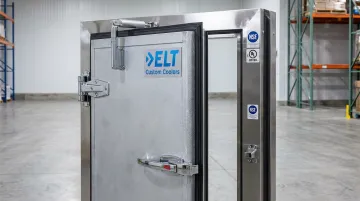
Units that carry these marks, such as those from ELT Custom Coolers, have been independently verified against industry standards. That verification matters both during health inspections and over the long run, when reliability and component longevity directly affect operating costs.
How to Estimate the Right Budget — and Avoid Common Mistakes
The right budget targets operational fit — your site conditions, storage volume, and 10-year cost picture — not just the lowest equipment price. Getting itemized quotes from multiple suppliers makes the full project cost visible before you commit.
ELT Custom Coolers, an American family-owned business with over 18 years in the industry, supplies replacement walk-in cooler and freezer doors, door hardware, frames, gaskets, and turnkey 8x8x8 walk-in cooler boxes for restaurants, food service operations, retail, and cold-storage facilities across the US. Buyers sourcing door replacements or modular cooler packages can reach their team at eltcoolerdoors.com.
Questions to Answer Before Setting a Budget
- What inventory volume needs to be stored, and how often will the cooler be accessed during the day?
- What's the site situation — indoor or outdoor, new construction or retrofit into an existing space?
- Are there compliance requirements — NSF, health department, DOE energy standards?
- What's the realistic total budget — including installation, site prep, and electrical work, not just the equipment price?
Common Budgeting Mistakes to Avoid
- Focusing only on equipment price and ignoring installation and operating costs — the full project cost is typically 30–50% more than the unit alone
- Choosing the cheapest refrigeration system without evaluating energy efficiency or sizing it to the actual load
- Over-specifying features that the actual workload doesn't require — a small cafe doesn't need industrial-grade components
- Failing to budget for permits, site prep, and electrical upgrades — these reliably appear in the final bill and are rarely optional
Conclusion
Walk-in cooler costs in 2026 range from $5,000 for a basic small unit to $40,000+ for large custom installations. The final number depends on size, refrigeration type, insulation quality, customization level, and site complexity — and none of those variables are fixed until you've assessed the actual project.
Understanding the full cost picture — equipment, installation, monthly operating costs, and ongoing maintenance — is what turns a purchase into a sound investment. The right unit balances upfront cost against long-term efficiency and the operational load it needs to carry. Once you know what you need, components like replacement doors and frames are often where hidden costs — and savings — actually live. ELT Custom Coolers stocks prehung replacement cooler and freezer doors in standard sizes and manufactures custom sizes in-house for non-standard openings, so if a door replacement is part of your project scope, that's a straightforward piece to resolve.
Frequently Asked Questions
How much does it cost to have a walk-in cooler installed?
Total all-in project costs typically range from $5,000 to $40,000+ depending on unit size, configuration, and site requirements. Installation labor alone generally runs $2,000–$7,000 for standard jobs, with site complexity, electrical upgrades, and unit size as the primary variables that push costs higher.
What is the lifespan of a walk-in cooler?
A well-maintained unit typically lasts 15–20 years. Lifespan depends heavily on insulation quality, how consistently the refrigeration system is serviced, and whether routine preventive maintenance is performed on schedule rather than reactively.
How much does it cost to run a walk-in cooler each month?
Monthly operating costs depend on unit size, refrigeration efficiency, door usage, and local electricity rates. Using the EIA's March 2026 U.S. commercial rate of $0.1364/kWh, a standard 8x8 or 8x10 unit runs roughly $150–$165 per month under typical operating conditions.
Do I need a permit to install a walk-in cooler?
Most jurisdictions require at least an electrical permit, and often a mechanical or building permit as well. Requirements vary by location, so check with your municipality early. A qualified installation contractor will typically manage the permitting process on your behalf.
Is it cheaper to build a walk-in cooler from scratch or buy a prefab unit?
For most commercial buyers, prefab delivers better long-term value. DIY builds frequently have hidden inefficiencies — air leaks at panel joints, insulation gaps — that drive up energy bills and lead to more frequent repairs. Prefab units are factory-engineered for consistent seal and insulation performance from day one.
How much should I budget for walk-in cooler maintenance each year?
Budget $200–$500 per year for routine preventive maintenance on a standard unit. This covers coil cleaning, door seal inspection, and refrigerant level checks — and is far less costly than a compressor replacement ($1,500–$3,000) or an emergency food-loss event.