Introduction
Walk-in freezers are among the most hazardous environments in commercial food service — and the numbers back that up. According to BLS data for refrigerated warehousing (NAICS 49312), the total recordable injury rate reached 3.4 cases per 100 full-time workers in 2024, with 2.9 cases resulting in days away, job transfer, or restriction.
A single preventable incident carries real operational costs: OSHA serious violations now carry penalties up to $16,550, with willful or repeated violations reaching $165,514. Worker's comp claims, food spoilage liability, and the reputational damage from a trapped or injured employee compound those figures fast — most operators find the cost of prevention is a fraction of a single incident.
Walk-in freezers operate at 0°F or below, with sealed interiors, ice-slicked floors, limited visibility, and documented entrapment risk. They demand stricter protocols than a standard cooler. This guide covers OSHA requirements, proper PPE, safe operating practices, installation-phase safety, and the most dangerous mistakes operators make.
Key Takeaways
- Walk-in freezers carry real risks — hypothermia, frostbite, entrapment, and slip-and-fall injuries — all preventable with consistent daily protocols
- OSHA mandates internal door release mechanisms, clean walking surfaces, and employer-provided PPE; workers under 16 are prohibited from freezer work
- Always wear full PPE before entering, regardless of how brief the visit
- Run daily checks on door release latches, floor conditions, lighting, and temperature readings
- Consistent daily habits — not one-time setup — keep freezer environments safe for every worker who enters
Walk-In Freezer Safety Guidelines
Walk-in freezer safety spans three overlapping categories: physical hazards (cold stress, slips, entrapment), equipment design compliance (OSHA, NSF/ANSI 7), and behavioral discipline (PPE use, communication, emergency readiness).
Freezers are distinctly more dangerous than coolers because of how hazards compound: a sealed, sub-zero environment with limited phone signal, potential ice on every surface, and a door that becomes a wall if the interior release fails. No single safety measure works in isolation — each layer compensates for the gaps in the others.
General Safety Precautions
PPE required for freezer entry:
- Insulated jacket and pants — protect against hypothermia, which OSHA defines as a core body temperature drop below 95°F
- Thermal underlayers — retain body heat during extended exposure
- Insulated gloves — frostbite causes permanent tissue damage and, in documented cases, amputation; an OSHA accident report documents a worker in a -10°F freezer who lost two fingers due to inadequate gloves
- Head covering over ears — extremities lose heat fastest
- Non-slip insulated footwear — ice and condensation on freezer floors are a constant hazard
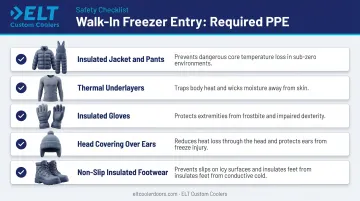
Under OSHA 1910.132(d)(1), employers must conduct a hazard assessment to determine required PPE, and 1910.132(h)(1) requires employer-paid PPE when that assessment mandates it.
Required behavioral protocols:
- Buddy system — staff must notify a coworker before entering, set a check-in time, and never work alone for extended periods during off-hours
- Carry a cell phone — signal may be weak but not zero; it's a last-resort communication tool in entrapment scenarios
- Keep floors clear — OSHA 1910.22(a)(2) requires workroom floors be kept clean and, to the extent feasible, dry; 1910.22(a)(3) requires walking surfaces be free of ice hazards; use non-slip mats at entry points and keep all pathways unobstructed
Safety During Installation
Behavioral protocols protect workers during daily use — but installation errors create hazards that persist for the life of the unit. The most common are improper panel sealing (air gaps cause ice buildup on floors and walls) and failure to verify safety mechanisms before first use.
Pre-commissioning checklist — verify these before the unit goes into service:
- Internal door release latch is functional and operable from inside
- Emergency lighting activates automatically on power loss
- Door alarm is connected and tested
- Temperature-indicating device is installed and visible (NSF/ANSI 7 Clause 6.7.1 requires at least one securely mounted, clearly readable temperature display per compartment)
Manufacturer installation manuals recommend a minimum 2-inch clearance between walk-in units and building walls for airflow — confirm the requirement with your equipment manual.
ELT Custom Coolers' walk-in freezer replacement doors include a lockable latch and safety release handle as standard hardware across their product line, along with a replaceable anti-condensate heat wire integrated into the door frame. Their freezer sliding door configurations come with heated jamb sandwich frames that prevent ice buildup at the door perimeter — a critical feature during the installation phase when the unit is being sealed and tested for the first time.
For temperature monitoring, the Kason 1967-A3 Dual Temperature Display & Switch is a compatible add-on that helps operators meet NSF/ANSI 7 requirements for visible temperature indication in each compartment.
Safety While Using or Operating a Walk-In Freezer
Temperature: USDA and NSF/ANSI 7 both require commercial storage freezers to maintain 0°F (-18°C) or lower. Even a few degrees of sustained drift signals equipment malfunction — and should be logged and acted on immediately, not monitored passively.
Behavioral risks that add up:
- Propping the door open too long destabilizes temperature and creates condensation on the floor
- Overloading shelves restricts airflow and creates falling-object hazards
- Using improvised step stools (chairs, boxes) instead of a proper step stool or ladder is a documented fall risk — OSHA's restaurant eTool explicitly calls this out
- Skipping PPE for "quick" entries — sub-zero temperatures don't care how fast you plan to be in and out
Lifting technique in freezer environments: Cold muscles fatigue faster and are more susceptible to strain. According to a NIOSH-hosted review on cold storage work, tactile sensitivity, grip strength, and manual dexterity all decrease in cold environments. Proper lifting technique matters more in sub-zero environments than at room temperature. Keep knees bent, back straight, and the load close to your body — and avoid twisting while carrying.
End-of-shift closing checklist:
- Verify no staff remain inside before securing
- Confirm the internal release latch operates freely
- Check emergency lighting functionality
- Log temperature reading and note any anomalies
Environmental and System Safety Considerations
Condensation and floor ice: The door frame and floor threshold are the highest-risk zones for ice formation — warm, humid ambient air meets the coldest surfaces right at the entry point. Inspect door seals regularly, and mop up moisture immediately when it appears. Anti-condensation heat wires in the door frame (a standard feature on ELT Custom Coolers' freezer door line) reduce ice buildup at the perimeter, but they don't eliminate the need for routine floor checks.
Power outages: FoodSafety.gov confirms a fully stocked freezer maintains safe temperatures for approximately 48 hours with the door kept closed. The food safety window is real — but re-entry after an outage is its own hazard. Darkness, ice-covered surfaces, and disorientation in an unfamiliar layout all increase fall and entrapment risk. Emergency lighting must activate automatically, not require manual switching.
Refrigerant system warning signs: Staff should know to report — not investigate — these:
- Unusual compressor sounds or pressure changes
- Unexplained temperature fluctuations
- Ammonia odor (at 300 ppm, ammonia is immediately dangerous to life and health per OSHA guidance)
- Ice buildup on interior walls or around refrigerant lines
OSHA 1910.36(b) requires enough exit routes from the facility, generally at least two, and 1910.37(a)(3) requires those routes remain free and unobstructed at all times.
Common Safety Mistakes to Avoid
Skipping PPE for Brief Entries
This is the most common precursor to cold-related injury. Frostbite causes permanent tissue damage — the OSHA accident record of a two-finger amputation in a -10°F freezer due to inadequate gloves is not an edge case. It's what happens when protection is treated as optional.
Establish a firm policy: PPE is required for every entry, regardless of anticipated duration.
Neglecting the Internal Release Latch
Three separate OSHA citations document this exact failure:
| Employer | Year | Citation |
|---|---|---|
| Kroger Company | 2022 | Employees exposed to frostbite and hypothermia; inoperable door safety button |
| Kosher Pizza Palace | 2011 | No mechanism to open the freezer door from inside |
| Maefair Health Care Center | 2008 | Broken and missing interior door handle on a walk-in refrigerator |
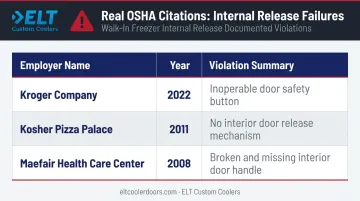
Operators typically discover a frozen or broken release mechanism during an actual entrapment. Build latch inspection into a weekly maintenance check and repair failures immediately. Cal/OSHA Section 3249 goes further, requiring that if a padlock is used without an inside release, an electrically operated audible and visible signal system must be installed and tested daily.
For facilities sourcing replacement hardware, ELT Custom Coolers' inside safety release handle (model 0481SA) is rated to -40°F and includes a glow-in-the-dark knob for visibility in unlit interiors. It's Kason-compatible and pairs with the 0556 stainless steel latch.
Failing to Train Staff on Emergency Procedures
OSHA requires employers to train workers on cold stress risks, symptoms, prevention, and first aid. NIOSH expands on this, recommending training that covers both self-monitoring and coworker monitoring.
Assuming staff know what to do if they're trapped — or how to recognize early hypothermia in a colleague — is a dangerous gap to leave untested. Run drills and post emergency procedures inside the freezer where they're visible.
Ignoring Early Equipment Warning Signs
Document and act on these immediately:
- Unusual compressor sounds or cycling patterns
- Ice buildup forming on interior walls or coils
- Temperature readings trending upward without explanation
- Condensation appearing around door seals that wasn't there before
Delayed response to equipment warnings typically produces two outcomes: food loss and a safety incident.
Conclusion
Walk-in freezer safety holds together when three elements stay intact simultaneously: compliant equipment design, consistent staff training, and daily operational discipline. Weaken any one layer and the others become less effective.
Start with a door and hardware assembly that has safety built in:
- Interior release handles rated for sub-zero temperatures
- Heated jambs that prevent floor ice formation
- Anti-condensate heat wires along the door frame
- Magnetic door seals that hold the cold barrier under daily use
Then layer in the behavioral habits your team runs every shift:
- PPE worn every time, no exceptions
- Buddy check-ins before anyone enters alone
- Closing checklists completed at the end of each service period
- Weekly latch and hinge inspections logged and dated
- Staff trained to recognize early hypothermia signs in a coworker
The equipment sets the floor. The habits determine whether that floor holds.
Frequently Asked Questions
What are the safety requirements for a walk-in freezer?
OSHA and NSF/ANSI 7 require an internal door release mechanism (panic bar), emergency lighting, non-slip flooring, adequate ventilation, and at least one clearly visible temperature-indicating device per compartment. Staff training on cold stress and emergency procedures is also required under OSHA guidance.
What PPE is required for working in a walk-in freezer?
Required PPE includes an insulated jacket and pants, thermal underlayers, insulated gloves, head covering over ears, and non-slip insulated footwear. Under OSHA 1910.132, employers must conduct a hazard assessment and provide required PPE at no cost to the employee.
What are OSHA's regulations for walk-in freezer workers?
Core requirements cover exit doors operable from inside without tools (1910.36(d)(1)), clean and dry walking surfaces (1910.22), employer-provided PPE after a hazard assessment (1910.132), and staff training on cold stress and emergencies. DOL child labor rules also prohibit workers aged 14–15 from working in freezers.
What should you do if you get trapped inside a walk-in freezer?
Use the internal release latch first. If that fails, call for help by cell phone and trigger any installed emergency alarm. California's Cal/OSHA Section 3249 requires a firefighter's axe inside qualifying cold-storage rooms as a last-resort option.
How often should walk-in freezer safety checks be conducted?
Daily: check temperature readings, floor conditions, and door seal integrity. Weekly: inspect the internal release latch and test emergency lighting. Monthly: conduct a thorough cleaning and review the refrigeration system for early warning signs of failure.
What temperature should a walk-in freezer be maintained at for safety?
USDA and NSF/ANSI 7 require 0°F (-18°C) or lower for commercial storage freezers. Any sustained temperature rise above this threshold signals a potential equipment malfunction. The sub-zero operating environment demands cold-stress protections for workers at all times, regardless of exact temperature.