Introduction
Picture this: a restaurant walk-in freezer runs warm overnight, and by morning prep the food inside has crossed into the danger zone. It's a preventable loss — and in commercial foodservice, it happens more often than it should.
According to the USDA, bacteria multiply rapidly between 40°F and 140°F, meaning poorly managed cold storage creates real food safety risks — not just wasted ice. The good news is that most cold loss comes down to a handful of avoidable mistakes.
Whether you're managing a walk-in freezer box at a restaurant, warehouse, or cold-storage facility, the physics are the same: insulation slows heat transfer, and every gap in your process costs you temperature.
This guide covers the practical steps to extend cold life at every stage — from initial setup and loading practices to door management and ongoing maintenance.
Key Takeaways
- Pre-cool your freezer box for at least 30 minutes before loading, and inspect lid seals and gaskets before use
- Pack pre-chilled contents only — the box maintains temperature, not creates it
- Aim for a 2:1 ice-to-contents ratio for maximum cold retention
- Keep the lid closed as long as possible; plan what you need before opening
- Store in the shade and away from heat-absorbing surfaces
How a Cool Freezer Box Actually Works
A passive cool freezer box doesn't generate cold — it slows the rate at which heat enters. Understanding this distinction changes how you use one.
Cold retention depends on three main components:
- Insulated walls that reduce heat conduction from the outside
- An airtight lid that limits warm air exchange when opened
- Thermal mass (ice, frozen packs, or pre-cooled contents) that absorbs incoming heat before temperatures rise
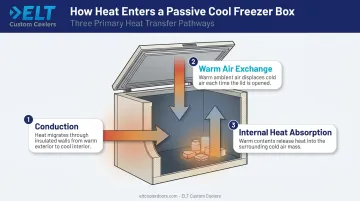
Heat enters through three pathways: conduction through the walls, warm air exchange when the lid opens, and heat absorbed directly from warm items loaded inside. Every technique in this guide targets at least one of these.
What This Means for Commercial Units
Commercial walk-in freezer boxes take these same principles to a much higher standard. ELT Custom Coolers' walk-in freezer replacement doors, for example, use R32 closed-cell insulation and dual-gasket systems, combining a magnetic door gasket with a double-sweep gasket at the base, to maintain a thermal seal through repeated daily openings under commercial load. The gap between a portable cooler and a commercial walk-in is precision: tighter tolerances, more durable materials, and sealing components engineered to hold up over years of heavy use.
Pre-Use Preparation: Getting Your Freezer Box Cold-Ready
Pre-Cool the Box Before Loading
A warm box is an ice-killer. When you load food into a box that's sitting at room temperature, the walls themselves draw heat away from your ice before the contents ever warm up. Pre-cooling eliminates that problem.
How to do it:
- Add a sacrificial bag of ice or two ice packs
- Close the lid completely
- Leave it for at least 30 minutes — overnight is better for multi-day trips
Use block ice or large-format ice packs for pre-cooling rather than cubed ice. Block ice melts more slowly, so it brings down the box temperature more efficiently without burning through your cold reserve before you've loaded a thing.
Start with Pre-Chilled Contents
A freezer box is designed to maintain a low temperature, not create one. USDA food safety guidelines are direct on this point: perishable foods should go straight from the refrigerator or freezer into the cooler. Meat and poultry packed while still frozen stays colder even longer.
Loading room-temperature cans, freshly bought produce, or warm leftovers into a cooler forces the available cold to fight heat from inside the box — melting your ice in hours instead of days, and pushing food into the bacterial danger zone above 40°F.
Smart Packing Strategies to Maximize Cold Retention
Layering and Ice Placement
Cold air sinks, so packing order matters more than most operators realize.
- Place densest, coldest items — raw proteins, frozen goods — at the bottom
- Layer ice directly on top of these items; cold air descends and chills the entire interior
- Lighter or dry items go higher, where temperatures fluctuate more
Fill Every Gap
Empty air pockets warm up fast and accelerate ice melt. A reliable rule of thumb: fill open spaces with towels, extra ice, or frozen water bottles — anything that reduces void space and adds thermal density. A full box holds cold significantly longer than a half-empty one.
Ice-to-Contents Ratio
Use a 2:1 ratio of ice to contents as a benchmark for maximum cold retention. That means for every pound of food or drink, you want roughly two pounds of ice or equivalent ice packs.
Ice type comparison:
| Ice Type | Best For | Trade-off |
|---|---|---|
| Block ice | Multi-day trips, duration | Harder to pack around items |
| Cubed/crushed ice | Filling gaps, fast chill | Melts faster |
| Ice packs/frozen bottles | Reusable, no meltwater mess | Less flexible shape |
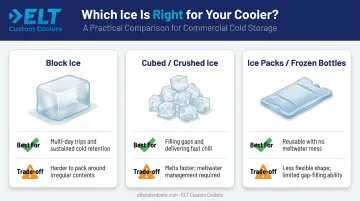
For extended storage periods, a combination works best: block ice on the bottom for duration, cubed ice filling the voids around items.
Use a Separate Drinks Cooler
A drinks cooler gets opened constantly — every 20 minutes on a busy service line, dozens of times a day in a food service setting. Food safety best practices call for a separate beverage cooler precisely because that frequency of opening dramatically shortens cold life for anything stored alongside it. Keep food in one box, drinks in another.
Operating Your Freezer Box the Right Way
Minimizing Heat Exchange During Use
Every time the lid opens, warm air floods in. There's no avoiding it — but you can minimize it.
- Plan before you open: decide what you need before lifting the lid
- Organize smartly: put frequently accessed items on top so you're not digging
- Close fast: don't leave the lid propped open while you rummage
- Keep the box level: unnecessary tilting causes meltwater to slosh and dilute remaining ice
On meltwater: don't drain it too early. Cold water does a better job of preserving remaining ice than warm air does. Meltwater keeps chilling your contents long after the ice starts shrinking — draining it prematurely just replaces that cold buffer with warm air. Food should be in sealed, watertight containers so it doesn't sit in pooled water.
Environmental and Placement Factors
Where you put the box matters almost as much as how you pack it.
- Shade over sun: keeping a cooler in shade can make ice last up to twice as long
- Avoid hot surfaces: black asphalt, metal car trunks, and concrete absorb heat and conduct it straight through the box base
- Use a reflective tarp or cover when shade isn't available
- Don't place against heat sources: generators, grills, or direct sun exposure all accelerate cold loss
The same logic applies at a commercial scale. Walk-in freezer doors are engineered with structural clearance around frames specifically to manage heat infiltration and condensation — controlling the environment around the unit is as important as the insulation inside it.
Common Mistakes That Drain Cold Fast
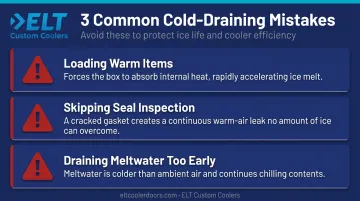
Three habits account for most premature meltdowns:
- Loading warm items: Even a few room-temperature cans force the box to absorb heat from inside, melting ice faster than pre-cooling or good placement can offset. If it wasn't in a fridge or freezer before it went in the box, it's working against you.
- Skipping seal inspection: A cracked gasket or warped lid creates a continuous warm-air leak that no amount of ice will overcome. Test by closing the lid on a piece of paper — if it slides out without resistance, the seal needs attention.
- Draining meltwater too early: Meltwater is colder than ambient air and keeps chilling contents around it. Wait to drain until genuinely necessary, and ensure food containers are sealed when you do.
ENERGY STAR notes that tight door seals prevent temperature fluctuations and energy waste in commercial walk-in units — the same principle applies to portable boxes where a failing gasket goes unnoticed until ice runs out hours ahead of schedule.
Frequently Asked Questions
How does a cool freezer box work?
Passive cool freezer boxes use thick insulated walls and airtight lids to slow heat transfer from the outside environment into the interior. They don't generate cold — they rely on ice, frozen packs, or pre-cooled air mass to maintain low temperatures over time.
Will a cool freezer box keep food frozen?
Most passive cool boxes maintain cold rather than freeze. They can keep already-frozen food frozen for a period depending on insulation quality, ice-to-content ratio, and lid-opening frequency — but they won't freeze food that starts at room temperature.
Do cool freezer boxes work better than cool bags?
Hard-sided boxes with thick insulated walls and gasket-sealed lids significantly outperform soft cool bags for cold duration. OutdoorGearLab's 2025 testing found the best soft coolers held temperatures below 40°F for 3.6 days, while top hard-sided coolers like the YETI Roadie 48 held that mark for 6.8 days.
Which cool freezer box stays cold the longest?
Premium hard-sided boxes with freezer-grade gaskets and thick polyurethane foam insulation consistently outperform budget models. Rotomoulded construction generally outperforms blow-moulded in durability and seal integrity, with premium boxes retaining ice for two to five days or more in real-world conditions.
How long does a freezer box stay cold with ice?
It varies considerably. Budget models may hold cold for 12 to 24 hours; premium insulated boxes can sustain cold for up to five days with proper packing and placement. Ambient temperature, lid-opening frequency, and ice-to-content ratio all affect the outcome.
Should you put ice on the top or bottom of a cool box?
Top placement is generally more effective because cold air sinks, cooling the entire interior from above. For multi-day use, layering ice both below and above contents provides the most consistent cold retention throughout the box.
Keeping a cool freezer box cold comes down to consistent habits. Pre-cooling, smart packing, controlled access, and thoughtful placement all work together — skipping any one of them costs you cold duration faster than most people expect.
For commercial food service, retail, or cold storage operations that need reliable performance under heavy daily use, ELT Custom Coolers supplies NSF-approved walk-in cooler and freezer replacement doors — including heated-frame options, sliding door systems for high-traffic environments, and gasket and sweep seal packages designed to hold tight thermal seals at scale. Explore the full catalog at eltcoolerdoors.com.